Episode #3: Ira Ingber
↓ English transcript ↓ | Traduction en français
Ira Ingber: Mindfulness, musicianship and production - A brief industry retrospective
Gabi Chesnet
Hey there, I’m Gabi Chesnet!
Cyd Levine
I'm Cyd Levine and welcome to Musicians’ Teatime! So, this is pretty exciting, because it’s been a while since we were both at our microphones like this; the reason being our intrepid host Gabi was traveling the wilderness of LA and got to interview some great musicians in their natural habitat.
Gabi Chesnet
That’s right! I’m decompressing back in Normandy right now, it’s been a very hectic and busy few months. I’m very thankful and honoured to have been able to get personally acquainted with some lovely people in music there in LA.
Cyd Levine
So, who do we have at the tea party today?
Gabi Chesnet
I’m very happy to introduce Ira Ingber, a music industry veteran, session musician, composer, producer, solo artist, long time friend and collaborator of people like Bob Dylan and Van Dyke Parks, and poster boy for all men born under the sign of Aries out there. He’s also notably currently working with Steve Bartek, John Avila and David Raven in a band called jackiO, which if you’re in the LA area, I really recommend you catch one of their shows. I thank him very much for welcoming me and having this conversation on topics too numerous and interesting to name outright.
Cyd Levine
Ira is basically a font of wisdom, he talked about a thousand different things that were all fascinating and I really enjoyed listening to this interview. The intro and outro music for this episode is by him, so if you’re listening to that and you’re like “wow, that sounds really good” - it’s his! Check it out. [GC: I will link to that.] So without further ado, let's get into it!
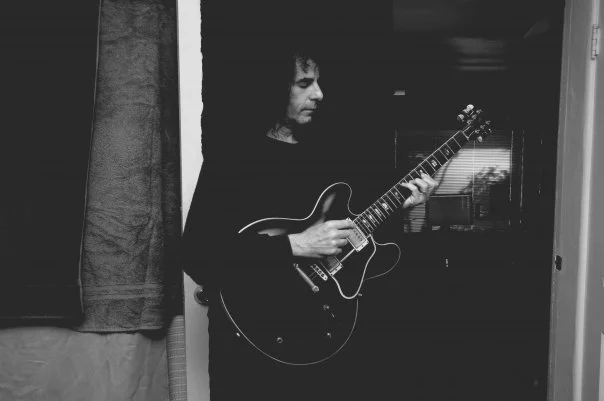
c. 2009
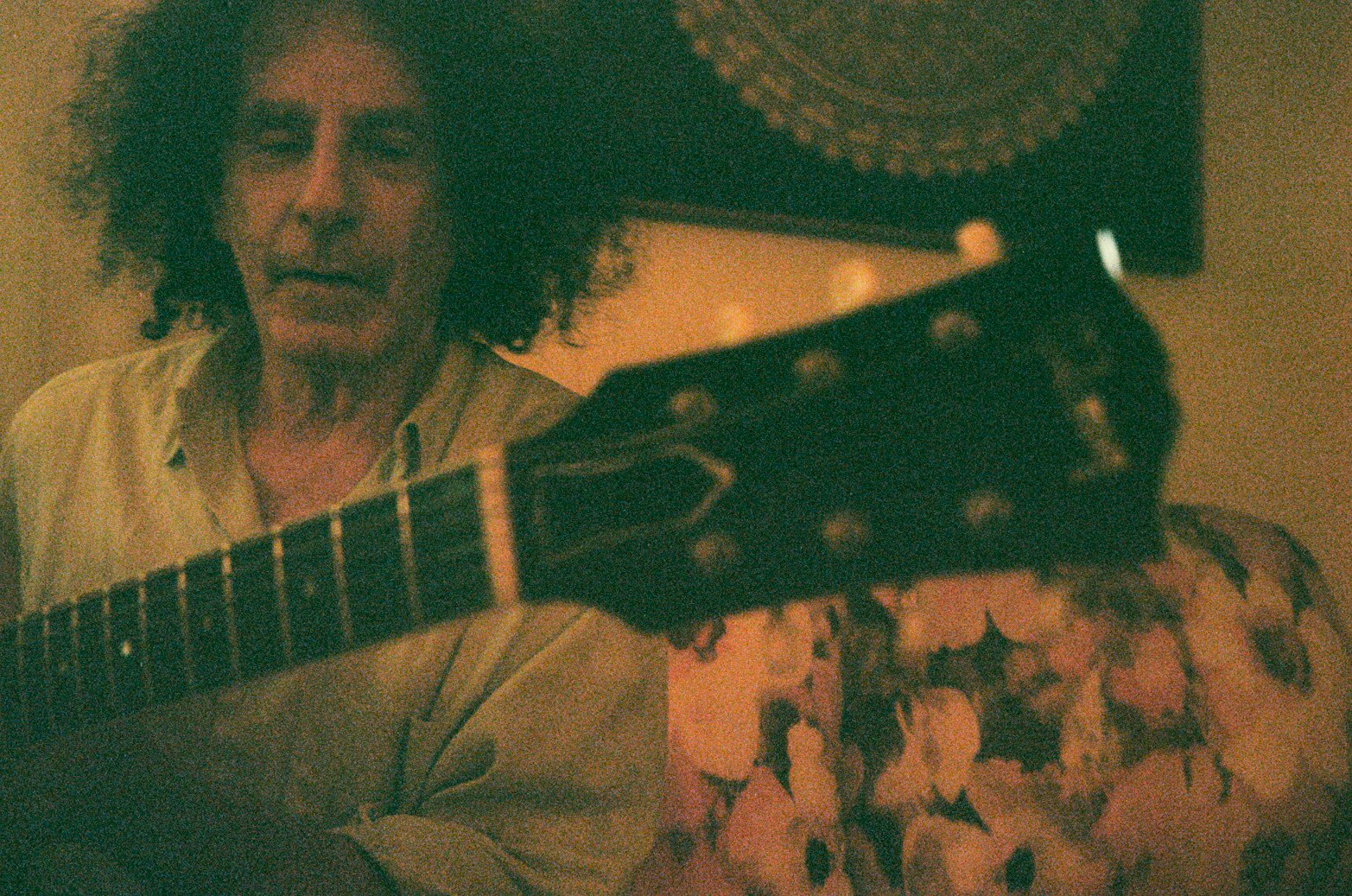
2021 - photo by Gabi Chesnet for AAR
Gabi Chesnet
Ira, thank you, and welcome to Musicians' Teatime. It's a pleasure to have you. [II: Thank you.] This is always a question that bothers people, but do you think you could tell us about what you do, what you've been doing since...
Ira Ingber
Since I was 12, you mean? (Laughs)
Gabi Chesnet
...in the realms of music, art, or whatever?
Ira Ingber
Well, I'm a musician, which is probably not a big shock. I grew up in Los Angeles. I was born in Minneapolis, Minnesota, my family came out here. I was quite young, but I still have a large family there. So the Midwest roots are still kind of there, we visit. But when I came to California, as a young guy, we were in the midst - not even in the midst - it was before the big pop explosion took place, of the early 1960s. And it was largely centered here. Although at the time, not all of us knew that. Because it all felt like it was England, the Beatles and all that stuff. But in fact, it was here.
The music business hadn't really migrated. It was centered in New York, largely. From the earliest days, all the big companies were in New York. Los Angeles, of course, was the film business. And one by one, these companies started coming out here, because the cultural changes were happening here first. Largely fueled by a few things: the Vietnam war, the peace movement, the civil rights movement, which was really around the country. But so much culturally was going on here, that specifically in music, these companies that had been based in New York, suddenly, were here. Warner Brothers gets out here. And then later, Columbia, CBS came out here, Atlantic came out here, they all ended up being here. But Capitol, which affected me directly, was here. Capitol was, I think, the only home grown Los Angeles major label.
And so when I was in a band, I was 16. I joined this band that had already been playing, I replaced one of the members, and we got a deal to be on Capitol Records when I was 16. And it was a big deal. I mean, the deal wasn't a big deal, but for me that was a big deal. But it was almost a natural thing, because it was the record company down the street. There was the local, and the Capitol tower, which is, of course, still there- Have you been in there yet? [GC: I've seen it.] You must go inside. [GC: Oh, you can?] Oh, yeah, they do tours. It's a working studio, there's still three rooms there. It's gone through a lot of changes, but the studios are legendary. They still sound amazing. And going in there then, and going in there now, aside from the new equipment, it looks the same. It's like a museum: famous pictures of all the people who recorded there- Nat King Cole, Sinatra, go down the list...
So this band I was in, called The New Generation, ended up on Capitol Records. And we rehearsed- they didn't know what to do with us. So they put us in one of the studios - B, as it turned out, which is a wonderful, smaller room, but good ensemble size - and we were there, rehearsing in this room. I would be looking around, and the consoles, of course, were very primitive in those days, it was all obviously analog stuff. But I would kind of peek in and say, "Well, what does that do? Oh, okay, that's, oh, that's a Hammond organ... That's a Neumann microphone." So I started seeing these things that attracted my curiosity in addition to playing. I had an early reel to reel machine, it was just a seven and a half IPS reel to reel that I always just sort of had, I was always recording things along with playing. So the two became part of the same thing. Recording and playing was an inseparable part for me, from the earliest days.
Being here, as I said, in Los Angeles was a huge advantage, because there was a huge pool of talent, there was a lot of opportunity, and the business part of it was inventing itself. And so you'd find yourself playing live, then in later years, going out and touring with supporting acts, or supporting an artist. More deals happened. But it was all because the opportunities were here. And I had an older brother who was in the business as well. I met a lot of people through him, and to this day, people I still work with. So the advantage was really just luck. It was just luck, being in the right place at the right time.
Gabi Chesnet
It's often the case in the music industry.
Ira Ingber
Yeah. I mean, I had some talent, I worked hard, but I was in the right place at the right time. If I was in, you know, Lafayette - well, Louisiana, maybe would have been different - if I was in Bismarck, North Dakota: No. It wouldn't have happened. It wouldn't have happened at all. It was happening in a very small geographic area where I grew up, which was the Beverly Fairfax area. A lot of later famous people went to the high school I went to. The Chili Peppers came out of there, before that Phil Spector went to that high school. It had a history because of where it was located, in the middle of Hollywood. So those kinds of things were all afforded to me in this very small geographic area. Capitol Records was two miles from my house. So it was one of those kinds of things.
Gabi Chesnet
So you got to do that, you were a teenager?
Ira Ingber
I was a teenager, yeah, I was very young. As I said earlier, it didn't feel unnatural. It felt like, "Well, of course! This is what you do, you're in music, you get onto Capitol Records". Later, I found out how unusual it was. It was very unusual for someone 16 years old to have a record deal on Capitol Records. I didn't know that at the time. [But] I knew it was special!
Gabi Chesnet
Even at the time, it seems like it was a lot easier to just walk in, make a band and have a record out. And now it's maybe a bit more saturated?
Ira Ingber
Oh, the business does not resemble itself at all. There were good and bad things about the old days. The bad things, in some respects, outweigh the good. They owned you. They were the gatekeepers. They decided who could record. They decided where you could record. They decided when you could record; and at the end, they owned it, and you were always in debt to them. But they have the means to distribute the stuff, they have the means to essentially decide who was going to succeed and who wasn't. It was in their power.
Gabi Chesnet
So they could make you or break you.
Ira Ingber
Absolutely. So you know, the people who pine for the good old days... There were really good things about it. The good part was that you were supported. When you went on the road, the record company paid for the hotel rooms - of course, you paid for it out of your own pocket later, but I like to call them a very high interest bank. They lent you money at high interest rates, but they lent you money! We got to work with some of the greatest engineers, talented producers and great studios. So that was all plus stuff, and I learned a lot along the way.
And as we started to see the system change, it's much like what happened with movie studios, again, using them as an example. There was a thing called the studio system in the 20's and 30's, 40's, 50's even. The big companies, Warner Brothers, MGM, Paramount, they owned the actors. You were signed as an actor to Paramount, and they would lend them. Paramount would lend out, you know, Cary Grant to work for this [other studio], and they would make deals with you. They were pawns, the actors were pawns. [GC: A bit dehumanizing.] Yes.
Then that system started to break down, sort of when the music system started to break down, when the actors and the directors broke off, and they started their own studios. Francis Ford Coppola did that. The early works of Spielberg and De Palma, those directors, they went off on their own. The studios weren't gonna - "You can't do that!". And they said, "Watch me". And they succeeded, and it broke down. The same thing happened in music, where there were always independent recording studios here in LA, but the dominant ones were owned by the record companies, and you could only record in their studio. When I was on Capitol, we had to record in their studio, because we were paying to record.
Gabi Chesnet
As is kind of the case with all of these sub-labels...
Ira Ingber
That's right. That happened a little later, but the subs were already kicking in. [GC: They answer back, in the end, to the big company.] That's right, and now it's kind of come full circle. So, Universal Music Group owns everything. They own A&M, they own Motown, whatever it is, they own everything. It's kind of like we went from the ownership of everything by the company, to then more independent, to now back to the company owning everything.
Gabi Chesnet
But to this day, do you find that you want to break out of that circle? Like, you've got solo albums.
Ira Ingber
Yeah, again, the good news for today - with the last 20 years - has been digital technology has created a lot of opportunities. We don't need to go to a studio facility to work. I have a room here. When the computer became powerful enough, and memory got cheap enough, go down the list - and plugins we can talk about later. When everything kind of reached critical mass, that was around, oh, I would say 2000-2005, somewhere in there. Around the time the iPhone came out. When that happened, the independent artist was liberated, because the independent artist could record when they wanted to, they could put out stuff when they wanted to, and at the end they owned it. That's the good news.
The bad news is, everybody's doing it. So how do you get attention? Well, then social media starts to kick in. And so people are yelling out, "Hey, I have a record", "I have a record", "I have a record". Now there's too much music. What's the statistic we've heard about YouTube? That what is it, 20 hours of programming are uploaded every second? There's no way to calculate. [GC: You can't really fight against the algorithm.] No! No. So how do you even get attention? How does an individual, independent artist get attention? Well, you band together sometimes, and you pull your resources, and then now we're back to a label. For example, JackiO - our little band - everybody in that band is a producer on their own. We all have our careers, and when we get together, we have this really big pool of talent, that so and so can do this; like I master records for David [Raven], our drummer's, projects; or John [Avila] will hire me or I'll bring John - I brought John and David in on a project I produced. So there's a lot of cross-pollination going on. Maybe we'll see more of that.
Gabi Chesnet
So maybe alone on your own, each of you, you've been less able.
Ira Ingber
Yeah, you need to band together. There's a wonderful quote of one of our early Founding Fathers, Benjamin Franklin - spent a lot of time in France, as you know. He said - this was on the eve of the American Revolution - I think it's something like, "We must hang together, or most assuredly we will hang separately". It's very true! The fact that we need each other, you know, and to the extent that in the music aspect, the music business- it's a predatory business. There's a lot of unscrupulous stuff going on. I don't want even get into what artists are now paid for streaming, but you're aware, it's a pittance, almost not enough to want to do it.
Physical media is no longer, so essentially the money that is made these days by musicians is by live performance, selling merch at the shows. And the one last area, which is what JackiO is focusing on right now, is licensing for television and film. We'll record things, we'll write things... We're working right now on a project we're about to wrap for a company that hired us to create original music for film and TV, trailers, web stuff. There's still money to be made there because there's upfront licensing. But the old days of being able to make an album, let's say, make an album and go on tour, do very well and repeat the process... It was album, tour, write, album, tour, write, album, and you would just do that. That's gone.
Gabi Chesnet
But one thing that's not gone, I feel like, is fan interaction, fan interest. [II: More than ever.] You have to have it in the sense that you're not going to make money off of streaming, but a fan who really likes what you do is going to buy the physical album. [II: That's right.] Even if they don't listen to it.
Ira Ingber
That's why vinyl - I have been telling people, people buy vinyl and never listen to it. I've got a bunch, there's some here and some over there. I never listen to it. I like looking at it, I like seeing it. I like knowing it's there. But you're right, fan interaction is critical. We have the means now to reach people we never could before. I have some personal fans - there's a couple in Sweden that I interact with and a couple in England, people around the world who have bought my stuff - we could never have done that before. So that's good. That's good news. It's plusses and minuses with this stuff. Being able to navigate the pluses and minuses is critical, because we have these tools that are unprecedented. These phones we've got, we have the ultimate means of communication. And it's never been so bad in terms of getting ahold of somebody, but we have the tools for it. Then every once in a while someone really smart gets together. Zuckerberg, for example, "Well, I can do this", and suddenly he's a trillionaire. So we as artists, as creative artists, I think the assets far outweigh the liabilities right now, although the liabilities are pretty substantial.
Gabi Chesnet
I think it's pretty interesting that you seem to have this outlook that is pretty different from a lot of people in your generation of musicians, who tend to sometimes have a misplaced longing... [II: How about pessimism? (Laughs)] No, it's different from pessimism! It's more like misplaced nostalgia for the past.
Ira Ingber
Oh yeah, I'm glad you brought that up. [GC: Things are just different.] Things are different! And you know, the past is truly gone. Okay, folks? It's gone. It's a legacy, if you want. If you want to dwell there, you will find yourself being very disappointed. I've had some very, very lucky moments along the way, and a few in particular that I think are worth even bringing up right now. This was many years ago, early 80's. I was working in a studio a lot with a friend of mine, we became friends, I was there all the time. I learned a lot of studio techniques by being in there every day. I didn't know one mic from another and I started to learn, "Oh, okay", I could cut tape, and suddenly, "Well, I'm getting pretty good at this stuff". One day, somebody came in with this big box - about this big - bunch of knobs on it, and he plugged it into the console. Okay, what's gonna happen? It starts. I'm hearing drums! It was the first Linndrum machine. It was the first drum machine that sounded like drums. It didn't sound like a TR-808.
Gabi Chesnet
Was it the beginning of MIDI?
Ira Ingber
It was just before MIDI. You jumped the gun here. [GC: I've got to brush up on that.] You jumped the gun, but I'll be there in a second. The studio had great playback, hearing monitors, big giant guys. It was clear as day: That's where we're going. That's it. It's not that it's the best thing to do, or that it's a possible way; No, that's where it's heading. [GC: It's what is next.] Yeah, it was just like a light bulb went, "Okay. That's it. That's where we're going". Then you started hearing those records, early 80's, Michael Jackson records. No drummer can play that - well, it's not a drummer. Then the sounds got a little bit more artificial, more signal processing, gated reverbs, things like digital reverbs and things like that. Treating these machines; MIDI happened then, and the dam broke. Because at that point, one person or two people could replicate an entire band. So the bass player's gone, the drummer's gone. The guitar, fortunately for me, was and still is harder to replace, because it's so random.
Gabi Chesnet
I find it extremely difficult. There's plugins, but...
Ira Ingber
You can. I've heard a million guitar plugins and I use some of them, just because they're easy and convenient. Sometimes they're really good for the task.
Gabi Chesnet
Or maybe, I mean in my experience, perhaps big chords or something.
Ira Ingber
Yeah, that's right. That's right, and atmospheric stuff. It's great. It works. But if you have four people here playing guitar, and I handed each one of them, okay, here, you play a C chord. Now you do it. They're all going to sound different. Now I want you to play a line, play, (sings riff). Same notes, same guitar, they'll all sound different. If you take a piano, they all sound the same. So it's, again, luck. Guitar wasn't going to get replaced, in some ways it rose to greater prominence. Saxophone, violin, those idiosyncratic instruments that are so- [car engine revs by] What's that sound? Let's record that!
That was an advantage to those players, because they became more personality. So you could spot Eddie Van Halen - "That's Eddie Van Halen. That's what he does. No one sounds like that." [GC: Kind of weeds out...] Yeah, exactly. That's right. It weeds them out. But for all the other stuff, for bass, string players, keyboard - I mean, I'm a lousy keyboard player. But with MIDI I sound really good. Right? [GC: Who doesn't?] Yeah, who doesn't?
Gabi Chesnet
Even an entire orchestra, you can replicate that with the BBC plugins.
Ira Ingber
Sure, and it happens every day. [GC: And it sounds natural.] That's right, and as the budgets came down - because the producers, the end users of these projects, wanted to take advantage of this stuff - they say, "Well, we have $5,000, can you give me a film score?" I'd say oh, I can't - you couldn't have done that before, but now you can. You work really hard, but in fact, it can be done. That became a problem unto itself because the more people said yes, the lower the budgets kept going. That's like what I was saying earlier about technology. It was very liberating, and provided huge opportunities, unheard of. But it also ensured the demise. It was almost like this self destructive thing, it was like this drug that we all took that was, "Yeah, this is great stuff". However, there's a price to be paid. And the price was, the ability to command a budget that was workable kept sinking, because the end user said, "Well, if you can't do it, this person over here will be happy to do it. They've got a computer set up at home, and they'll just crank it out". And for a lot of music that's just as wallpaper, like a documentary, or a commercial- you don't need 10 people. You need one.
Gabi Chesnet
That's true. But there's this difference in what the person who's commissioning an artist will want. Because if somebody is willing to work for cheaper, it's not going to be the person who's going to hire the entire string quartet, or the orchestra.
Ira Ingber
That's right, yeah. And if you have the opportunity as a listener, to hear a maybe single-person based score, versus a bunch of people playing, you're always going to pick a bunch of people. [GC: Not everybody can tell the difference, though.] Well, I disagree. [GC: I think I can, but...] I know - I think most people can, even laypeople, even people who are not professionals. They're going to pick up, there is something that hits us here in the heart and the ear from humans making music together. We saw this during the pandemic, this was a really telling example of that.
So all during the pandemic, we didn't - at least I didn't, most people I know didn't - we weren't playing together. You saw probably online, all of these squares of jazz guys, or classical people playing, and it looked great, you know. There's the bass player, and there's the drummer- and none of them were playing together. Because there's the issue of latency. That was the brick wall. We couldn't get anything below, we couldn't get anything close enough to 10 milliseconds, 15 at the top, latency. Unless you can do that we couldn't play together. So I would play something, I would send it to you, you play it, you send it out there, he plays it, and then someone at the end puts it together. It sounds a lot like music, but what's missing is the nonverbal communication.
What's missing is the emotional context of being in a room together, where so much happens that is not articulated verbally. And when I got back earlier this year to my first in-person session, it was like I... besides going to heaven (laughs), that's where it started, the things we never thought about, such as playing together, such as the nonverbal cues, all that stuff we never thought about, because we never had to, because it never stopped. [GC: And we were taking it for granted.] Yeah! You never would have thought of it. But as soon as it's taken away, it's the only thing you think about. Then suddenly when we're back, it's like, "Wow, this is amazing", and it continues to be that. When you saw us the other night, that was only our third time of playing as a band live since the pandemic. We've done a couple things. We passed a few files around to each other. It's just that with that band, it's not the same. That band is about spontaneous interaction.
Gabi Chesnet
And that translates off very well, from what I saw. [II: Yeah, that's what we do.] You're interacting with one another, and it makes one happy to see you guys. [II: Yeah!] You're smiling at one another.
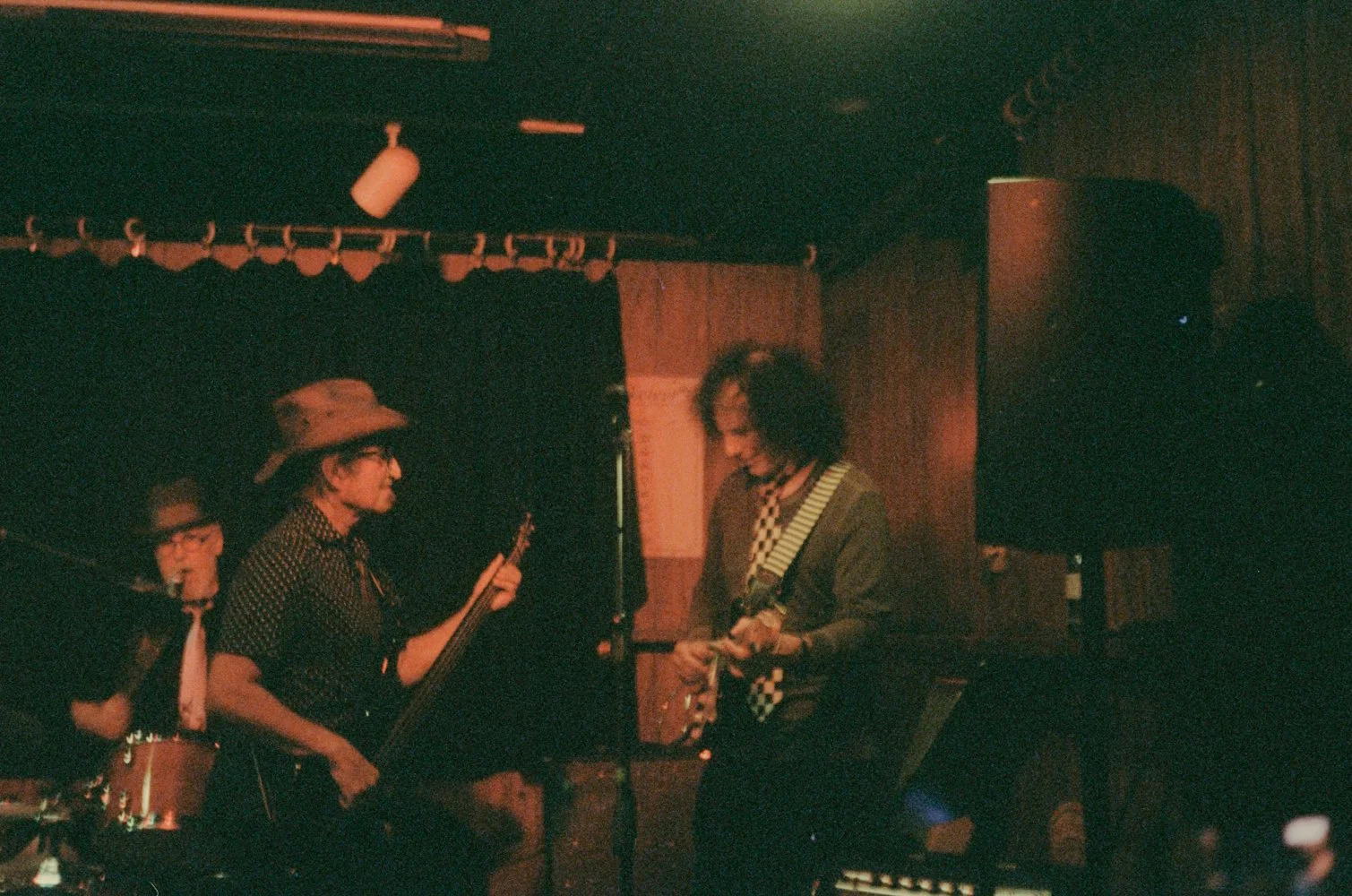
jackiO at Ireland’s 32 (Van Nuys), by Gabi Chesnet for AAR
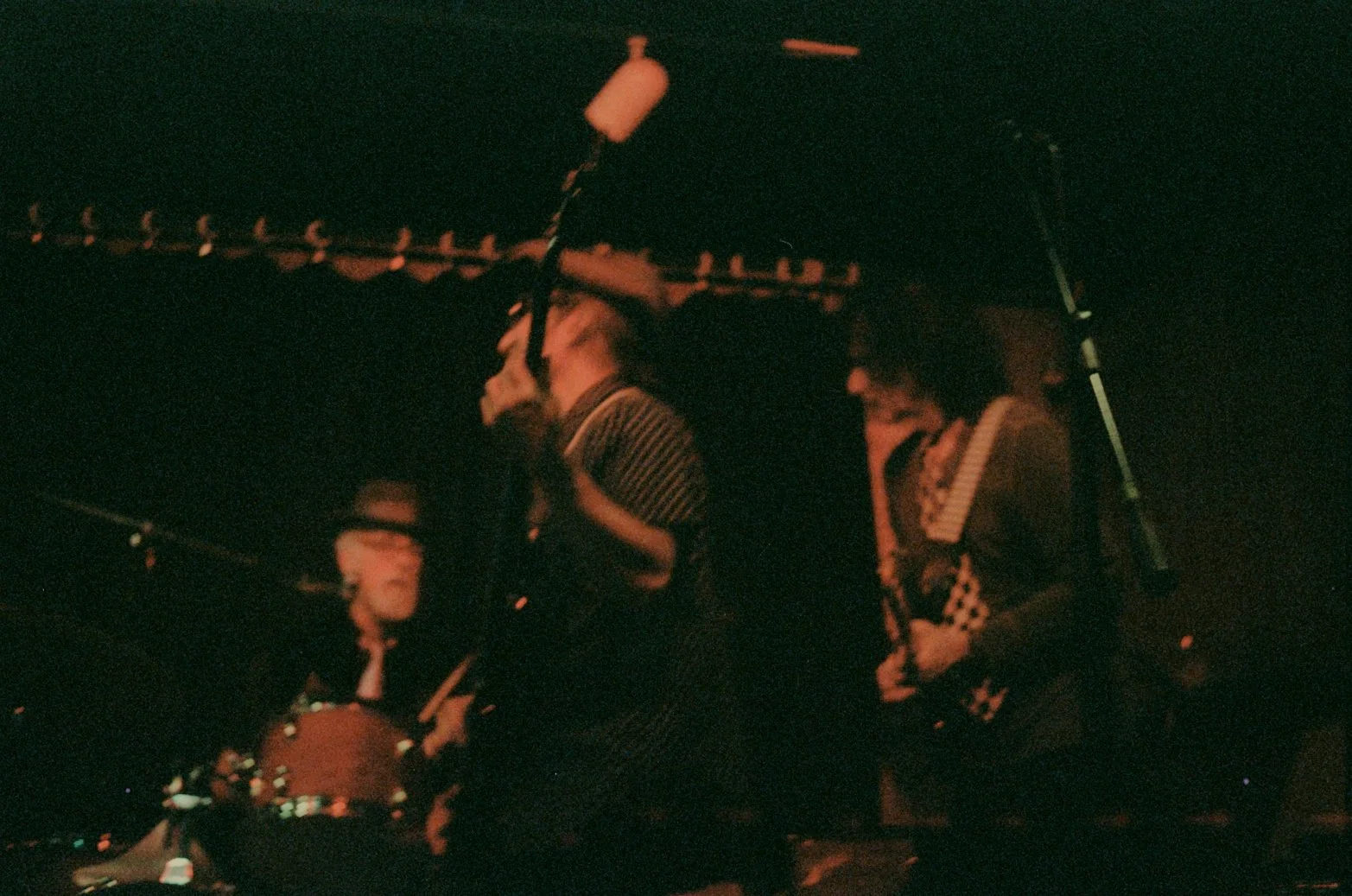
L - R : David Raven, John Avila, Ira Ingber
Ira Ingber
We're happy. The audience is happy- the audience is happy, we get happier, it throws back and forth. [GC: You can tell there's chemistry between you guys.] Yeah! All of that stuff, you're right, it was taken for granted, because we never had to think about it. Well, now we do. Just yesterday, as I said, we were working on these recordings, and we're in the room together. The only problem we usually have is that we have too many ideas. There's never a shortage of ideas. These are all very accomplished musicians in this band, and these guys, we have enormous respect for each other, and we have a lot of fun. But also, we have a sense of each other's strengths. And we play to the strengths. This is probably going on all around the world with musicians getting back together again, after this very dark time, moving on.
Gabi Chesnet
I do get that feeling that it's something that I wasn't really paying attention to before the pandemic when I have played with people in a room or on stage. But you do jam and seem to improv quite a bit. Just tell me if I'm wrong, but... [II: Oh, we do.] You definitely do, and sometimes you don't even have to look at each other. But it's all in the body language and the way that you seem to, like jazz musicians, just get in the zone.
Ira Ingber
Yeah, that's exactly right. In the case of our band, it's mutual trust, mutual respect. We know each other really well now. So I know that if I just look at David, our drummer, he's gonna do something, I just do this- (laughs) and he just does it! Or I'll look at John, our bass player, and just go... and he's there.
Gabi Chesnet
Do you feel that you're leading something?
Ira Ingber
If I'm leading, if I'm thinking we should [do something], I'll just do that. I'll just do that - (nods) - it means, keep doing it. Or don't do that. Stop. I've been described... I'm not the leader of the band at all. There is no leader, but I'm kind of like the first among equals. I tend to be more of a sparkplug for them. "Okay, guys, we're gonna do this tomorrow", send the email out. "We have a show here, be there at 7 o'clock". Now the other guys do too, but I tend to be more the initiator. But as I said, they're all extremely accomplished. Steve Bartek, in particular, he's an extraordinary... I mean, his skill set is. He's an orchestrator for Danny Elfman, and he was in Oingo Boingo with John. So it goes back with his stuff, and we've known each other a long time. I've worked on a few Danny Elfman movies.
Gabi Chesnet
Is that where you met?
Ira Ingber
We got to know each other better. We have a lot of mutual friends. But we got to know each other well during those movies. Then we kind of lost touch, because Boingo was still active. And then some years later, we crossed paths... You know, "What are you doing?" "Well, I'm not playing enough". That's what Steve said. So we started playing and one thing led to another. I had another earlier band, and we just play, we love playing together. I love playing with another guitar player. There's so much that can be done with two. Because I mean, there's a lot of people who are just solo artists and that's what they do, but I love the interaction of two guitars. I hear it almost orchestrally, and Steve does too. So we just find our spots.
And that's a lot of magic. That's a lot of just automatic communication, that again, you take for granted. I never took that for granted even before the pandemic, but certainly during, and now coming out of it... [GC: It just hit you harder.] Yeah! Yeah, I think we haven't sorted it out yet as a human race, how we move forward from this stuff. But I think we're all profoundly affected by it. You can see by the enthusiasm of audiences returning to venues, they feel starved for something to give them that thing that was missing, that they didn't know they missed, when it was there all along.
Gabi Chesnet
It's hard to describe the feeling of just being happy seeing a band because they're happy playing. [II: Yeah!] For me, it's like that, seeing happy musicians.
Ira Ingber
Yeah, that's exactly right. In that way, they say there's the silver linings from the pandemic, some good part of it. I think that's part of it, it's that we have a renewed sense, a renewed appreciation of things that are really critical, and more central to our lives than maybe we thought. Because it was always just there.
Gabi Chesnet
I do agree, not many people want to admit there are maybe some silver linings here and there. It's difficult.
Ira Ingber
There's some. There's some, because it's been a tough time for all of us, you know, very, very tough. We've lost people, personally. But I have to believe it'll be many years of looking back. What was this thing? Big events seem to do that to humans. Like you can't take it, it's too big to take in, and especially since we're not even done yet, you know?
Gabi Chesnet
So it affects you personally, as a person, but then as a musician, and it affects the environment in music itself.
Ira Ingber
Yeah, because musicians, we are empaths, right? We have antenna, we have sensitivities, that maybe a lot of other people aren't quite tuned to the same way. So the things that really affect us strongly, eventually filter down and affect other people. But yeah, I think as we move forward, there's going to be more of a sense of just figuring out what really happened.
Gabi Chesnet
I don't think we ever forgot, but we took for granted more and more being in the same room as people, interacting and enjoying people's company. Whether it's with a guitar or not. [II: Yeah, I agree.] There's something good with that. But so that band, how exactly did it come about? When?
Ira Ingber
JackiO came about by somehow a coincidence - of course, we know there aren't any. We all knew each other, but we never played together. I knew John, John and Steve of course were Boingo, David and John work together. Steve and David didn't know each other, I think they played once or twice years ago. But they're the most distant of the circle. David and I were in a band some years ago, briefly. It was at an art opening, art installation. He was playing with this other guy. We hadn't seen each other in a while. "What are you doing?" "Ah, not much...". So we said, well, let's get together. It was very quick. "Well, we should get him and him in a room", and as soon as the four of us got in a room, it was magic. And that was it. It was just like, "Okay, let's do this".
Now, the difficult part is that we do have lives and schedules. So we would fit in when we could and then we started, people wanted us to play, and we make it more of a priority. Because you have to, it doesn't just happen unless you plan it. So we instigate reasons to get together. It was very clear - to people who saw in the very beginning too - this is really special, these people have been around. But, there's something new here. There's something I haven't heard before. And it's not that we're playing music that's completely unique, because it's not at all, but the way in which we do it, the care in which we do it, the intention. It's about intention, that everyone is in the moment. That's the critical part. You are in the moment. You're not thinking about, "Did I lock the door to my house?", "Did I pay the bill?". No, you are here doing this right now. Mindfulness.
Gabi Chesnet
Exactly, that's the word, mindfulness.
Ira Ingber
It's a mindfulness exercise, the Buddhist monks have been doing it for thousands. It's the same stuff, it's the same stuff.
Gabi Chesnet
It's a very good remedy for anxiety, even just listening and you know, vibing to the music.
Ira Ingber
Yeah! Being in touch with where you are, in this moment. This moment you and I have right now is the only one that exists, and the one that we started at about a half an hour ago is gone. This is the one we have. That's a really tough thing to keep going for the Western mind. I think Eastern, at least old, when they had their philosophy stuff together, when they when they weren't so driven by materialism - they had that together over there. So it's a practice I try to do. I practice almost every day.
I play guitar almost every day, because for me, it's a very physical discipline, that if I let a few days go by, and I pick up a guitar, it's like... "This feels... kind of foreign to me". Whereas I know a lot of people who pick it up, put it down, pick it up, they play great. Two weeks later, three weeks later, a month later, no problem. I can't do that. [GC: Like riding a bike.] Yeah, it's not automatic for me. I've had to work at it. As I said, I had some God-given talent, but I worked hard to develop it. And I still have to work hard to develop it. I don't just get it and it's there, I have to keep it going, because it requires maintenance. And there's the physicality as I said, there's the mental part of it. I try to learn new things as a musician, and then you compound that with learning studio technique. Like we were saying earlier, plugins.
So I've signed up recently with Plugin Alliance, you know about those people? They're drug dealers. [GC: Pretty much!] They're German drug dealers, I love them - on the record, okay, we're recording this - I mean, they're making great stuff. A friend of mine said, "Oh, sign up for this thing". You give them a yearly $149, whatever it was, and you get to use all the plugins, you're essentially renting them. Then if you want to own it, then well, they have these specials. You probably see them, right? Every day?! Every day, I'm going to get an email.
Gabi Chesnet
You have to unsubscribe!
Ira Ingber
Well, here's the funny thing that happened two nights ago. So this friend of mine said, "Oh, the Black Box". I don't even know what it is! "Put it on the master bus. It sounds great." So I was messing with it, put it on. It's got mid/side adjustments so you can spread the stereo field, all the mid/side stuff was there - tube saturation, emulation, all this great stuff! But you know, "air", what is that? Give me a frequency. No, it's just "air". Well, it's probably 10k and up, I don't know. It was on sale. Of course they give you the coupons. "Okay, I'll pull the trigger." So I clicked in, logged in, okay, I'm about to buy it. They said - little prompt comes up - "you already own it". (Laughs) I said, well, there's the problem. I didn't know I bought it! I mean, I truly had forgotten that I bought - I haven't been using it. But the relentless marketing kept me on edge enough to go "Well, better buy it", because it was gonna run out at midnight tonight. They put a time restriction on it. I just thought this was hilarious. I already owned the thing that I was wanting to buy? Really? I can't count, and you probably also, you can't count the plugins you own now. There's too many.
Gabi Chesnet
Well, you become kind of a hoarder.
Ira Ingber
Yes, that's a good way of looking at it. And this was years ago too, I remember when the first sample libraries, drum sample libraries - which I have a lot of, Addictive Drums, EZ drummer, I got a couple of others. And this is part of the human condition too, that I think is worth talking about for a moment. So I have 10,000 drum kits, 20,000, whatever it is - more than you can possibly ever hear in a lifetime - and I'm now going to put a drum kit together for something. I'm going to use probably the first one, two or three snare drums I hear, and I'm not going to hear the other 20,000 probably ever. Because "Oh, this works. I like it." - Done.
There was some study I'd heard some years ago about giving people too many choices. [GC: Oh, definitely.] Right? So you go in - I don't know what it's like in France, probably more like here now - you go down the aisle in the supermarket, and there's 20 different detergents for laundry. First of all, it smells horrible. But why 20?
Gabi Chesnet
I think it generates anxiety in the shopper. [II: That's right.] Which makes them buy quicker without thinking.
Ira Ingber
Well, that's a good point. Supposedly what happened when emigres from what was the Soviet Union, when they only had one choice, they would go to a Western market and they got anxiety, like, "What do I do? H-how- What do I do?!"
Gabi Chesnet
Grocery shopping here makes me anxious.
Ira Ingber
I'm sure. I'm sure it does. Tell me some differences between here and France.
Gabi Chesnet
I feel like in France, things are not as huge anyway. [II: Right.] You go down the aisle and you go, well, things make sense. I feel like the aisles don't make sense in the US.
Ira Ingber
Well, they're designed to keep you in the aisle here.
Gabi Chesnet
Yeah, but no, I just want to go get my thing and logically go get the other, which should be around the corner.
Ira Ingber
No. You've got to go around the whole market to do that.
Gabi Chesnet
And not have to pick between so many choices... [II: Right.] Usually in France, the prices go from [top to the bottom shelf] more expensive to least expensive, but that's not always the case in the US either. [II: No, no.] It's confusing, you become anxious and you're like, "I just want to get out of this supermarket!"
Ira Ingber
Years ago I was playing in Las Vegas for... she was a pretty big artist. Horrible place. Have you been there? [GC: No.] You don't need to go there. You don't need to go. Knowing you as little as I do, I think you don't need to go. I'm not a gambling person, so maybe that's why I really hated it, but I realized it was a big... Which one was it? It was one of the big ones. To get from my room to the room that we were playing in, I'd walk through the casino to get there. You immediately get lost in the casino, and that's by design.
Gabi Chesnet
I think I've been to one casino, near Sacramento, once. [II: Yeah, those are different.] That was still massive.
Ira Ingber
The whole idea is to disorient you, so you don't know. Shopping malls do that here, or they used to. Once you're inside, you have no idea which way out is - it's designed intentionally to keep you in there. Moving back to plugins... (Laughs) Nice segue, huh? It's the same thing. It's designed to keep you in anxiety. "Oh, you need this one." "Oh, you need this one." Have you ever been to NAMM [National Association of Music Merchants]? You probably haven't been to a NAMM show, or what have you? The one that we have here?
Gabi Chesnet
Do I look like I get invited to NAMM?! (Laughs)
Ira Ingber
For your listeners, it's this big international - was, now it's gonna be in June, it was always in January - here in Anaheim, 30 miles from here. 130,000 people - it's a mob from all over the world. The original intention of NAMM was, the manufacturers would come and show their things to the buyers, the music stores and the retailers, other places. Then slowly musicians were kind of filtering in. So then you would have celebrity musicians doing endorsements and you'd have people playing, and it became kind of a show. The intention was still the interaction between the manufacturers and the retailers. But in the last, oh, I don't know, 20 years, maybe? Maybe longer. The design was to get musicians - or I felt this, and other people agree - unless you have this piece of gear, you can't work. You need this. You have to have this thing. So it becomes this big buzz, "Oh, you have to pick, you have to buy that.", and then next year, "Oh, you have to buy this". And you start to realize - I started, maybe I was slow in realization - that it's all design. It's all intentional design to keep you in anxiety.
Gabi Chesnet
Exactly. It's part of marketing. It's part of the reasons I dropped out of marketing school because I could not ethically cope with the psychological implications.
Ira Ingber
It's designed to get people to buy. You know, there's a very famous... Edward Bernays. You ever heard of him? [GC: By name.] Worth looking up. He was Sigmund Freud's uncle. [GC: Oh, makes sense.] I'm sorry - Sigmund Freud was his uncle. Mix up. [GC: Still makes sense.] He's the father of modern advertising. He died in the 40s, I think. Critical thinking person. He's the one who convinced Henry Ford to not only have black cars, they needed to have color for cars. He is almost single-handedly credited with having created the concept of want over need. So, I need a roof over my head. Okay, I want it to be a pastel color roof. That's different. I need shoes. I want Adidas Michael Jordan, or whatever.
Gabi Chesnet
Brings back memories from marketing school, with the pyramid of needs.
Ira Ingber
Yeah. This fellow, he's worth looking up. There's great videos on him. It was all by design, and we live - most of the world - in the aftermath of this. I don't want to spend more time on this - because I can't remember the things - I mean, I find it fascinating.
Gabi Chesnet
You can ramble as long as you want.
Ira Ingber
I'm rambling. You got me, you got a rambler here.
In the early 1900's, in this country, women couldn't vote. They had a thing called the suffragette movement, where women were petitioning for the right to vote. Seems ludicrous now, but women couldn't vote until, I believe it was 1920, or it was the 20th amendment. It's somewhere around there, after World War One. Bernays, very cleverly - and it's in the story, the documentary - associating women smoking with liberation, with getting the right to vote; well, they're going to show their defiance, "We're going to smoke in public" - you couldn't smoke in public, smoke cigarettes - "And this will empower us to get the right to vote", and it worked. So women smoking, you see all these pictures of these suffragettes smoking cigarettes, because it was their way of saying, "Okay, we're not only going to do this, we're going to vote, and we're going to get it". And he put that dot here, and that - put them both together.
And so, Plugin Alliance... (laughs) is right in the heels of Edward Bernays. I'm sure he's very happy about it, wherever he's looking down from.
Gabi Chesnet
Absolutely. I mean, we're creatives so we think always that we're in it for the art, but in the end... "Agh, I need this and that, and I won't be a good artist, or a good musician if I can't do all these things."
Ira Ingber
Yeah. It's so seductive. It plays on your fear.
Gabi Chesnet
Yes. Fear of missing out?
Ira Ingber
Yeah! Yeah. Well, I don't have that thing, I don't have the fastest computer, I don't have the... What can I do? Fortunately for guitar players in particular, in many cases the older the better - not always - but I have older guitars and they're great. New ones are good. The new, new ones are very, very good, by the way. I'm working with Gibson right now - not working, but I sort of have this artist thing with them. The brand new guitars are wonderful. They had a lot of bad ones for a long time. New ownership now, but guitar really hasn't changed that much, electric guitar, in really 60 years.
Gabi Chesnet
It just depends what you do with it. [II: Yeah.] Because what we have, I mean in the music project that I have, what we tend to do is to run the guitar through an Axe-FX. [II: Sure.] You can play for hours with that.
Ira Ingber
Yeah, it's a blank slate. Electric guitar is kind of a blank [slate]. You can do so much with it. You can make it sound like anything.
Gabi Chesnet
Anything, absolutely. I mean, my friend showed me, the friend that I do music with... [II: So you play the guitar as well.] I play a bunch of everything- guitar, bass, drums - and so we just had the guitar and we were switching from effect to effect, and I was being blown away with what it can do.
Ira Ingber
Yeah, and it gives you more ideas.
Gabi Chesnet
I think that's what we work off of - personally. I don't know if that's what you do? [II: Oh, sure.] Sometimes you'll hear a sound and you're like, "Oh, I can do that."
Ira Ingber
Oh, absolutely! Oh, sure. Steve and I, we have a little side project called BarIng All - I'll have to send you some of our stuff. BarIng - Bartek-Ingber, last names, "bar-ing", so BarIng All, it's kind of a play on words. We've got one of our songs; I bought a plugin, it was an Eventide black hole reverb. Love it, love it to death. [GC: Love Eventide.] You know that one? Yeah. So we plugged it into this thing, and it just made us play stuff. It sounded like ghosts, we put it on the drums, it had a very long pre-delay. So it would be, (claps out long delay). You'd hear the reverb like, I don't know, 100 milliseconds later, you'd hear the effect kind of bloom.
I looked at him and I said, "Did you say something?" He said, "No!" "What is that sound? Oh, it's that we hear from the... It sounds like people are talking in here." That became the title of the piece. People are talking. [As an] example.
Gabi Chesnet
So is that what inspires you to write, whether it's been stuff that you've done in the past or stuff that you're doing now, this? Is it the ideas that come from the sound, or the words?
Ira Ingber
They come [from] all kinds of places. Sometimes I'll wake up - I keep a pad of paper by my bed and a lyric will just almost wake me up, happens a lot. (Laughs) It's funny because I don't want to wake up. I'm just, "No, I don't want to wake up!", but I'll forget it. "Oh, shit. Okay, I have to..." So I'll write it. What did I write? Because sometimes it's even in the dark. So that happens. A lot of times my fingers will just lead me to something. Or I'll hear the sound of a bird, you know? (Hums birdsong) There's something that distills through the ears into the brain, and it comes out the fingers.
Gabi Chesnet
So you tend to feel the sound more than feel the words, in most cases?
Ira Ingber
Probably 70-30 sound to words. 60-40. A lot of words- I write a lot. And it happens, I can't control it. Some people can just turn on the tap, and it turns out okay. [GC: I wish.] There are people who can do that. Most can't. Most can't, but the good ones can. I worked with Bob Dylan years ago and I watched him do that. We were recording a piece called Brownsville Girl, pretty famous song of his. It's a 12 minute piece. 11 minute long? Very long song. We were recording it, and he stopped. He said he was short a verse. So I said, "Well, let's come back to it". (Laughs) He said, "Hang on a sec".
He went off into a corner, took out this pen that was about this big - tiny, tiny little piece - 10 minutes later comes back, maybe not even 10. "Let's start running it down", we start playing it. We knew which one was missing, because I remember hearing the verse scheme and that I would know the new one. So we get the new one, and it was... He starts singing it. Wow. It was great. He just did it like that. That's him.
Gabi Chesnet
That's very Bob Dylan.
Ira Ingber
Yeah, that's him. So, most people can't do that.
Gabi Chesnet
Would you say that like you write about [specific things] though? Like, is there a theme, because I feel there might be a theme with the clocks?
Ira Ingber
Ha! (Laughs) That's kind of a funny story, on Time Sensitive. You've heard part of that record?
Gabi Chesnet
I've tried to listen to all of them.
Ira Ingber
Well, thank you. Thank you. I've tried too! (Laughs)
Gabi Chesnet
I think "tried" is a terrible word to use!
Ira Ingber
I've tried to listen to them! No, what happened with that record was very funny. I was about halfway done, and I hadn't listened to them in sequence. I said, "Well, let's see where I am right now". So I sat down and listened to them; and to my horror, time was in every one of them. Some mention, some lyric mention or intonation. "Oh... No, this is no good... It's a theme!" [GC: Exactly.] "Ah! I knew that." (Laughs) Not. So it kind of steered me towards what became Time Sensitive. I was sensitive to time. [GC: Subconsciously.] Yeah, well, subconsciously yes, and then consciously. But you've heard the phrase "time sensitive". How do you say it en français?
Gabi Chesnet
Depends on the context.
Ira Ingber
Like, "you need to see this right now. This must be viewed right now". One says it's time sensitive. Is there no term for it?
Gabi Chesnet
Ah... my brain is empty. But I'd say "urgent", as in urgent.
Ira Ingber
Urgent, okay. Same thing. [GC: A sense of urgency there.] Yeah, same thing, urgency, right. So it's a play on words with me, that it's urgent, and it's also that I'm very sensitive to time. Clocks in particular, everything about clocks; digital clocks in our studios, which maybe you don't know or know something about. A critical part of digital audio, which is worth talking about for a moment. When I first got into digital audio, transitioning from analog, I felt like I had wings, you know. So liberating... Wow! I can edit, I can move things around, I can copy, paste, we couldn't do that stuff. You could, but it was very hard to do. Reverse something - very hard.
And I remember having real difficulty in mixing low end. Bass, kick drum, I couldn't figure out why. Because it wasn't a problem in a big room. Off of analog tape, you could just hear everything; okay, the bass is too loud, oh, we got it. I was going back and forth, I was up too loud, not loud enough. And then - because I didn't know anything about digital clocks, and somebody told me or I read, I forgot where it was, "you need to have a master clock", that governs the placement of the audio. Now, this is the early days of digital interfaces. The clocks were lousy, it's called jitter. They were inaccurate. So that at any given downbeat- I want that kick drum there, and I want this event, and I want it there, not here, or here, I want it right there. A lot of those early clocks couldn't do it.
Gabi Chesnet
That's the point, because we didn't think about keeping time.
Ira Ingber
Well, it's not even that it was out of time. It's out of time by nanoseconds [GC: It matters.] It matters. Amazingly, it mattered because we're not getting resolution. So as soon as I got my first clock, and I've had four since, because they keep getting better The one I have now is great, Black Lion Audio, wonderful piece of equipment. As soon as I got the clock, I could hear everything. I could line up- there's the kick, cymbal decays sounded normal now. Mostly it was those fast transients. Snare pop, kick drum, something went "ack", because the clock now says, I want you to play this at bar 52 beat three, right there. It wasn't doing it before the clock showed up.
Gabi Chesnet
It's only digital clocks? Because there's this visual theme I do think you have.
Ira Ingber
I do have a thing about clocks, too. I have in my studio an old school clock. This is an interesting story, the invention of the electric clock, which was mostly American, as it turned out. The reason it got invented was that as power companies came into being, Thomas Edison, everybody else here - and I'm sure you had your equivalent over there. How do you sell power to the public? How is it gauged? How do you keep track of the flow of energy through the walls? Well, it became kilowatt hours, 60 cycles. One of the pioneers of the electric clock was a guy named Lawrence Hammond. Does that name ring a bell at all? You ever heard of a thing called a Hammond Organ?
Gabi Chesnet
Oh!
Ira Ingber
He was one of the early inventors- a lot of people were working on it, he was one of them. There's 60 cycles coming out of the current, he put a coil together - he had a bunch of other people, but he was credited - and two wires to a coil, it's going to turn at 60 cycles. It'll be exactly what-o'clock depending on the accuracy of the grid, which has changed now. The grid floats around here. It's not constant now. So my electric clock kind of moves- two seconds, three seconds, it moves a little bit. It's not an atomic clock. So I'm fascinated by that stuff. That all came together on Time Sensitive. The digital clock, the analog clock, our biological clocks, everything's kind of ticking. The heart is a clock.
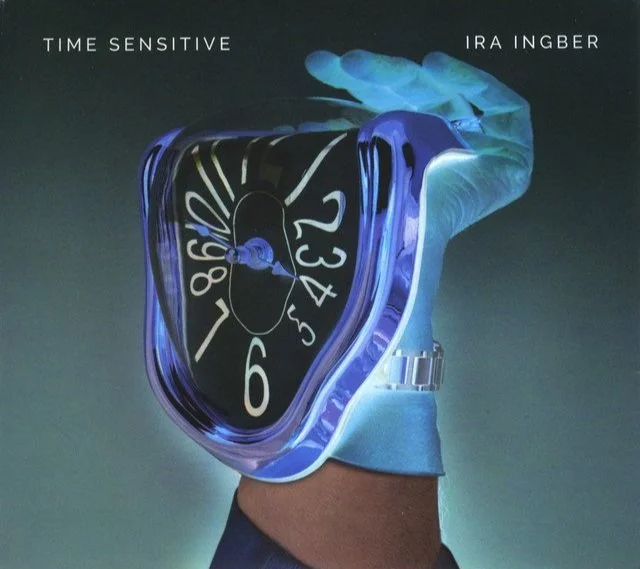
Time Sensitive (2015)
Gabi Chesnet
Are you chronophobic? [II: Afraid of time?] Afraid of the passage of time.
Ira Ingber
No. Is there a term? Or did you make that up? (Laughs)
Gabi Chesnet
No, it is a term! I was searching for it myself.
Ira Ingber
No, no, it's a great term. No, no. I can't take it in. I have a difficult time with birthdays. I mean, 20, 30, 40- they don't make any sense to me, because it doesn't compute to how I feel or how I look out. Some years back, there was a study of centenarians, people in their early hundreds. What was their secret? This one guy, 103, he said, "You know, I get so confused because I feel a certain way, but then I look in the mirror, and I don't recognize that person. I feel different than the person I see". Another one says on his birthday he always memorizes a poem, every birthday. That's his job, it's to memorize a poem.
Gabi Chesnet
The same poem every year?
Ira Ingber
No no no, new. A new one. Same one's easy. But all of them had expressed the same story of being very difficult for them to take in the passage of time. Not that they're phobic about it, just that it didn't compute. The ones were in good health, critical part of it. So the clock stuff with me was really a combo of things.
Gabi Chesnet
There's a whole bunch of interesting stuff... Like using the sound of a purring cat in one of your songs.
Ira Ingber
That's right, my cat Agnes. Yeah, Perfect Stranger.
Gabi Chesnet
Perfect Stranger. Which album?
Ira Ingber
That was Fact Flavored Fictions. The second album of mine. She, as you know from these animals, they're knowable and not knowable. Cats especially, they're just a little different. We had her for 20 years. I was working on something for that record, she wanted to be in my lap, and she started purring. I thought, "Okay, time to sing". So I took my very trusty SM57, put it right next to her and I started really petting her a lot. It's not that much enhanced, she was really purring loudly. I just moved it around... "Okay, there's a good spot. Okay, thank you much, you can go now." So yeah, that was the kitty purr.
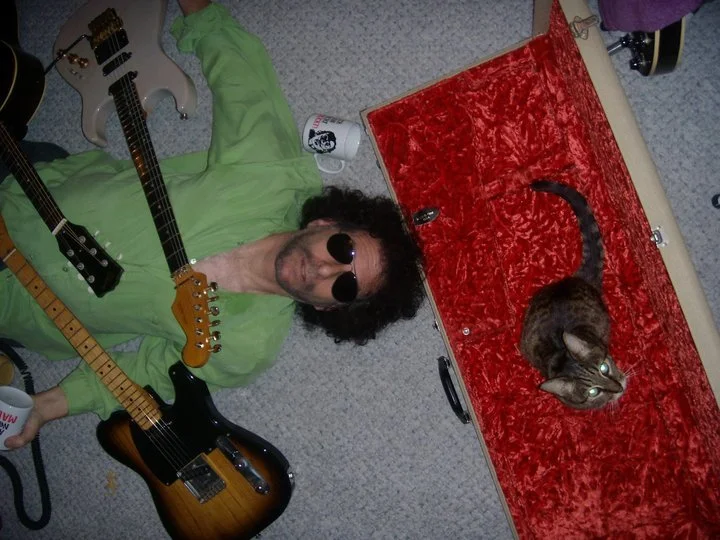
Ira and Agnes (c. 2010)
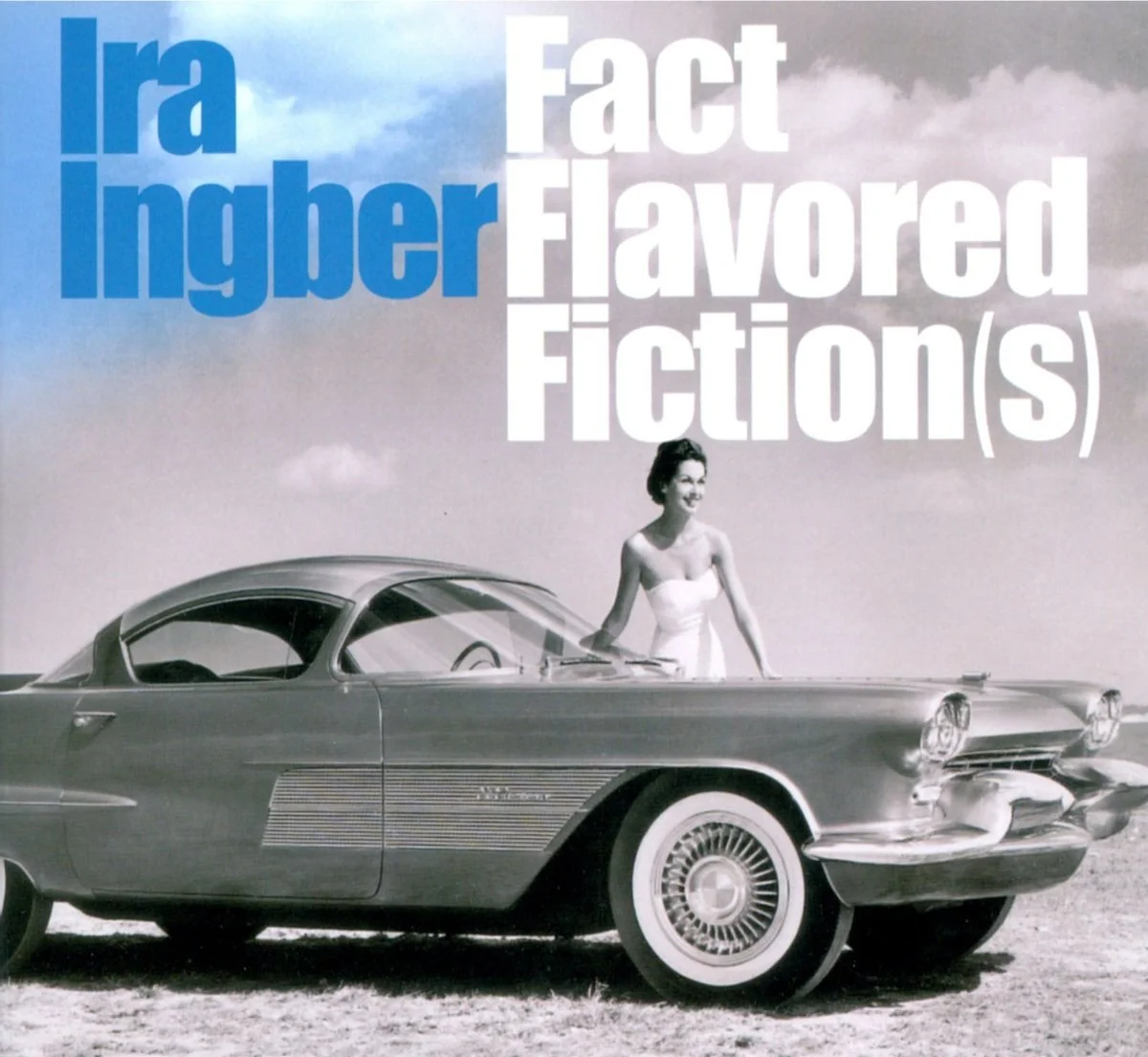
FactFlavoredFiction(s) (2011)
Gabi Chesnet
I find it really comforting. [II: Yes, yes.] As in, your music, it's comforting in the sense that it feels like home away from home.
Ira Ingber
That's a very nice compliment, thank you.
Gabi Chesnet
It's kind of hard to put into words, but there's something familiar about it, and unfamiliar as well.
Ira Ingber
Well, that's my intention as a creative person. You want to create something with your signature on it, so to speak, and at the same time, you want it to be something that has familiarity, so that it's not alienating people. So it's a balancing act, of sound in this case. Some things that will draw people in, there's some sounds we hear that are very, very particular to a time and place. Mellotron is a good example.
Gabi Chesnet
To a time and place... I think your music just makes me think of here. [II: LA?] LA, that's right.
Ira Ingber
I would not be able to know that.
Gabi Chesnet
I don't know. I mean, when I listened at home, it hit very differently than when I listened here. Here, it felt a lot more like he was made to be listened to...
Ira Ingber
...here? That's funny. See, I could never know that. [GC: Because you've made it here.] Yeah, I have no ability whatsoever to know that this sounds like anything to do with Los Angeles at all.
Gabi Chesnet
Maybe that's good, to have a perspective from somebody from another country.
Ira Ingber
Yeah, well, that's very important. It is. The time and place is essential. I was talking about the Mellotron, the old tape-based - the Beatles used it a lot. Strawberry Fields, you know, the classic, the opening... (sings tune)
Gabi Chesnet
What I wouldn't give for one of these.
Ira Ingber
Well, you don't want the maintenance costs. They're horrendous.
Gabi Chesnet
Mhm. I like the plugin.
Ira Ingber
The plugin's great, yeah, we don't want the real thing. So as soon as you use one of these things, which I did on my first record, it's instant. I played it for my wife, and she- "Oh, it's so... it makes me feel, you know, nostalgia". It has those sounds that are so imprinted in us, you hear if somebody do something like a Jimi Hendrix sound or whatever, it doesn't matter what it is, those things have emotional resonance. So you try to use them sparingly so you don't just have a cheap trick to get people in. You want to use it like seasoning. [GC: Like a craftsman.] Yeah, just use a little bit, a little goes a long way. And you can kind of tell, when I play for people, what they react to, and then sometimes they'll lean towards this thing. "Oh, okay. They like that thing. They got that one there." There are sounds that will put people off.
Gabi Chesnet
Sometimes it can be fun to put people off.
Ira Ingber
Yeah. Well, anything, if you get any kind of reaction, you're doing well.
Gabi Chesnet
That sense of home, not really nostalgia, happy nostalgia for a time that doesn't exist... [II: Well, that's very kind. I like hearing that.] There's that song, Across the Dial. [II: Mhm? That's on the first.] It's on the first record. I think I was just idly listening to it, must have been on the plane or just getting there, and I felt very surprised. I was like, hang on, I gotta replay this.
Ira Ingber
(Laughs) Well, that's my intention with most everything, for my own stuff. It requires multiple listenings. There's too much to take in, and that's good and bad news. There are a lot of people you can hear, "Oh, God, I love that. I get it. I'm there". My stuff you have to hear a few times, because there's a lot, there are layers. There are layers to discover, there are layers to find. There's a wonderful quote of Joni Mitchell, who I hold in very high regard. She was asked years ago, something like, the question was, "Do you hope to find out more about yourself as you write in your songs?" And she says, "No, no. I hope you'll find out more about yourself". And I thought, boy, that's really the right thing.
Wherever the stuff leads you as a listener, it takes you somewhere you would want to go - or maybe someplace you don't want to go, but you have to face. Whatever it is, it takes you someplace, it's doing something. It's having an effect, as opposed to, "Well, that's nice. Would you please pass the salt?"
Gabi Chesnet
Yeah, it's not just... [II: It's not background.] It's not like, "Oh, cool background music". It's something that you listen to and you're like- "Hang on, that makes me kind of emotional".
Ira Ingber
It's supposed to do that, and that's good that it caught that for you. It's difficult - it happens. The more you do it, the better you get at it, and the less you have to think about how to do it. It's automatically built into the system to the extent that it does become relatively unconscious. It's just the way you work. You know this when you're creating things, I'm sure, how do you know when something's right? How do you know what's the right part? You know, because number one, you can live with it. Right?
Gabi Chesnet
It's hard to listen to your own stuff.
Ira Ingber
Yeah, but at certain point when you feel like you had a successful day, a successful outing, you can say, "Yeah, that's good. That works. Oh, that doesn't work. We got to fix that thing. That's not right, here". How do you know these things? How does one know these things? You know it because your inner compass, your inner receptors, let you know these things. It's only instinct. There's no right or wrong. There's no meter.
Gabi Chesnet
It's the antennas.
Ira Ingber
Yeah, that's right. So you make these assessments. "Yes. No. Yes. No." I've had to do this. It's a skill that I've gotten good at, because I had to get good at it. And that was being able to produce myself. I can produce other people easily. That's easy to do. How do you be honest with yourself and not overly critical, or not critical enough? It's that balance, right? So if I'm singing a vocal, let's say - or a guitar, it doesn't matter what it is - and I'm hearing it coming over the speaker - or headphones, wherever - I have to change hats. Now I'm the person listening. I'm the producer saying, "Okay, well, good. That's a good... No, we need to fix that one". You can't fall in love with your work, and you also can't hate it.
Gabi Chesnet
How do you do that switch?
Ira Ingber
I can't tell you the process. I just had to learn how to do it. I had to be what I call dispassionate about my music. At the same time, I'm being passionate about it.
Gabi Chesnet
You distance yourself from it.
Ira Ingber
Yeah, you have to do both. You have to be very close, and then be distant, and be able to switch back and forth. Or sometimes be in both places at once.
Gabi Chesnet
I mean, it's not even a decade that I've been doing this. So it's quite daunting.
Ira Ingber
Right. So you're learning the process of having to be really critical. I know people who, you can't record them because they hate everything they're doing. So my job is to say, "Just play. It'll be great. Let me work it out". Singers especially, "Oh, that's terrible. It's terrible". Come back, I'll do a composite vocal through five takes, "Wow!".
Gabi Chesnet
Usually vocals are the worst.
Ira Ingber
Well, they're hard because it's so vulnerable. It's so emotionally exposed.
Gabi Chesnet
Raw, unedited vocals...
Ira Ingber
Yes! It's very difficult. For people who are not confident, or they have issues going on, they're troubled, there's something going on - sometimes you get the best vocals out of that. But doing it for myself, that was hard to do. I had to learn how to do it because I realized if I'm going to make this stuff, I have to be able to be objective at the times when that's the only thing you have going, and be completely subjective at other times. When I'm playing or singing, or whatever I'm doing - no objectivity, or little. I'm just playing. I'm just doing things. Okay, what do we got? (Clicks tongue.) Switch gears. Now I'm being objective. Okay. Yes, yes, no, no, no, yes. You start to get a sense of being where that balance is.
A couple, three weeks ago, almost a month now - David, our drummer, hired me. He's producing an artist, a very talented singer and good writer, and he wanted me to play guitar on the record. So I did that. And being a producer, being a writer, being a singer, being a guitar player, makes me a much better side person than if I didn't do those other things. Because I know what she's going through. I know what she's going through, she's putting it all in here. She's working hard. I want to support her. I know that those moments of vulnerability and rawness and exposure are tough for anyone.
Gabi Chesnet
Do you think that can tie into a point that I kind of wanted to get to, which is mental health as a musician?
Ira Ingber
Absolutely. Oh, gosh. Yes. [GC: At any age.] Yes, absolutely. It's critical.
Gabi Chesnet
Do you think it's under-addressed?
Ira Ingber
I don't know. There's a lot of really crazy people making music.
Gabi Chesnet
I mean, depends what you mean by crazy.
Ira Ingber
I mean, unbalanced people. Not healthy, not well, but then they're making music and suddenly everything's okay.
Gabi Chesnet
Because music can be catharsis. [II: Very healing. Yeah.] Also, when you're somebody who's going through very difficult things, it can be hard to look at your music in an objective manner, and be like, "Okay, well, this is fine and not everything I do sucks all the time".
Ira Ingber
You see, there's people like that. The "everything I do sucks" people. And if I'm being hired to work with them - or whatever, producing - my number one job is to not let them dwell there. I distract them from it or say, "Well, you're wrong, not everything you do sucks. Some of the things you do suck, but not everything. Let's find the stuff that doesn't and focus on that." Then there are others who are very competent about it, who have a very clear sense of purpose, joy in what they're doing, and they're not beating up on themselves. I find the older musicians are better at that. They don't beat up on themselves as much as the younger ones do.
Gabi Chesnet
Maybe the experience factor.
Ira Ingber
I think so, yeah. You're more aware of what your toolkit is, you know, "I'm good at this. I'm not good at that. Let's work with the good stuff".
Gabi Chesnet
Maybe you tend to compare yourself less?
Ira Ingber
I think so, yeah. You're less competitive with yourself. [GC: With yourself and with anybody.] Yes. If you're just doing what you think is the important work. [GC: You do it for yourself.] Yeah, and hopefully, it's something that will translate for other people to hear- "Oh, there's humanity here. We're communicating." I'm doing something that's universal in some way. That's hitting people where I'd hope it would be hit. I think older people, older musicians, have an advantage to that, in that if they've survived that long being musicians, they probably have figured out that beating up on yourself is not a survival technique.
Gabi Chesnet
Do you ever do that?
Ira Ingber
I'm sure I did. I didn't stay there. Yeah.
Gabi Chesnet
You can't just stay there.
Ira Ingber
Yeah, I was competitive with other musicians. If I would see someone who was better, "Well, I gotta steal from that one". I still do to some extent.
Gabi Chesnet
That motivates you, it doesn't make you feel down.
Ira Ingber
Yeah! It makes you feel like there's still a lot more to know. I mean, guitar specifically - artists in general - when you think you've arrived, as a guitar player, you're dead. It'll come up and slap you in the face, and someone who's a 15 year old, 10 year old kid, is going to play [Satriani's] Circles. "Oh, okay, I better get back to practicing again." You know, just when you think you know everything, you don't know anything, and that happens over and over again. You never can get self-satisfied you've arrived. You're always arriving. You're always evolving. If you're going to be a vital artist - and I've seen this with everyone I work with who's been doing it a long time - all of them have that in common. The constant push. I have a dear friend of mine, Van Dyke Parks, who's a wonderful artist, if you know of his work. We've worked a lot together over the years. He's gonna be 79 years old, and he's tough as nails.
Gabi Chesnet
Is he still working, still learning?
Ira Ingber
Oh, he works all the time. Still learning. Eh, he doesn't learn as much because he doesn't listen as well, but he's hilarious. He's one of the funniest people on the planet. But he said to me some years back, when he was feeling down about something, he said, "You know, my best work is still ahead of me". I thought that was so inspiring, that he is not looking back, nostalgic. Couldn't care less. I would ask him about old sessions - legendary records. He's, "I don't remember them. I don't care about it".
And it's funny too, thinking about this, I had an encounter a few years back with Malcolm McDowell, the actor. We were doing this show together, and I love his work. I thought he was an amazing actor. I said, "Oh, I'm just- It's such a thrill to meet you". We were sitting like this. We were in the green room, hanging out in this thing. And I said, "So when you did this movie, you know..." He said, "I have no recollection of any movie I've ever done". I said, "How's that possible?" He said he intentionally purges his memory. He said, "Otherwise I'd be so filled up, I wouldn't be able to memorize anything new". He said he looks at old movies of his - which he doesn't do much of as I recall - he said, "I have no recollection of ever doing any of it".
Gabi Chesnet
It helps to move on.
Ira Ingber
Exactly. And the same thing with Van Dyke. You know, he played on some really wonderful record I love and I said, "So how did you-" "I have no idea." which I found impossible to take in, but now I get it. He moved on! He's not holding on to that stuff, because it doesn't matter. There's no record of it.
Gabi Chesnet
It really, really makes me think of a state of mind that I used to have a few years ago, when I first met the person that I make music with, who used to be known as a shredder. More of a guitar player who was really creative. They would spend hours and hours-
Ira Ingber
(Mimics shredding scales)
Gabi Chesnet
- Hybrid picking, whatever, slapping, whatever, they could do anything. It would just make me feel terrible about my skills and I wanted to quit, but I talked about it with them, and they said, "Well, when I see somebody like that it just makes me want to practice even harder every day to get to that level."
Ira Ingber
Mhm. That's right.
Gabi Chesnet
I know there's a difference between "they're too good anyway, why should I try," and "they're good, I should try".
Ira Ingber
Yeah, that's the balance. That's the balance. You want to feel as though that's gonna motivate you. You don't want to feel that intimidated. You use it as a motivational tool for yourself. So again, it's always about that balance. Going back to what I was saying earlier about being able to produce myself, being very involved, and then being very dispassionate, being removed, and finding that area where sometimes they are coexisting in the moment. That's the real tough one. How do I care about something when I don't care about it? It's a real contradiction.
Gabi Chesnet
Even outside of music.
Ira Ingber
Yeah, but specifically in working, in the studio; and it's a learned skill, you have to practice it like anything else. You don't come into this world knowing this stuff. So you have to learn how to do it.
Gabi Chesnet
So there's something maybe comforting that you could say to younger artists who struggle with that, who maybe get self conscious, that it's okay, you don't have all of the experience. You don't have everything yet.
Ira Ingber
Yeah. You're gaining experience by doing it.
Gabi Chesnet
You're on the learning curve.
Ira Ingber
Yeah, exactly. If you don't do it, you will not get anywhere and you'll just be back criticizing yourself. That trick is finding that balance between the elements of self-critical, paralyzing nature and extreme egotism. "I'm so great, blah blah blah." Those kinds of things on the extremes don't serve anything, you know. And again, working with some of the really extremely talented people I've been fortunate to work with over the years, they all have that in common. Hard work, they're all hardworking people. They have a pretty healthy sense of themselves, and they're willing to learn more.
Gabi Chesnet
That's kind of the Holy Trinity of learning to be a better musician.
Ira Ingber
Yeah, yeah. They all have that in common, every one of them, with their own specific brand of it. Those are things you want to learn for yourself. So, you know, what do you say to a younger person coming into it? Work hard. Pay attention. Listen. Listen more than talk.
Gabi Chesnet
I think that's something that's frustrates me a lot, that some people will look at somebody playing like, "they've got a gift", when it's so much hard work to put in every day.
Ira Ingber
Innate talent, I think, is one of the most overrated aspects of an artist.
Gabi Chesnet
It kinda makes somebody feel bad if they worked so much and put so much effort in.
Ira Ingber
I know this very talented - he's an acquaintance of mine - perfect pitch, he was a child prodigy on the piano. And he rests on that. He had this amazing gift. He had this huge skill set. Amazing facility. Great. He figured that was enough. Sorry, necessary, not sufficient. Gotta have it, but that's not the whole salad. That's part of the deal. Again, the people who you know, as artists who you admire, whose work you like, whoever they are, they all share this in common. That trinity you brought up, and also the fact that there's a sense of wanting this to reach out, they're not operating in a vacuum.
Gabi Chesnet
Well, that's what you said, like you have to band together. We don't live in a vacuum.
Ira Ingber
Yeah, that's right. Yeah. I'm sure in this world, there are probably hundreds, thousands, millions, I don't know, lots of people whose work we'll never hear, who could be great. But for whatever reasons, they don't want to let it out. They're sitting around in a dark room, playing, writing, painting, whatever it is, but something in them doesn't allow it out. Because maybe it's not good enough, maybe I'll be judged. The judgment part is a real tough one for people. Self-judgment - very difficult. Got to get rid of that one. Because it doesn't serve anything.
Gabi Chesnet
Easier said than done.
Ira Ingber
Yeah, [but] it just doesn't serve anything. Nothing good comes from it. Let other people judge you, and then you can say, "Well, thanks so much. Appreciate the time. See ya". When you start judging yourself harshly, especially, it's a dead end street. You can't possibly get anything good from it. You can't move on to actually learning and listening.
Right, right. Fixed up the world right there, didn't we? (Laughs)
Gabi Chesnet
That's something we say in French, I don't know if there's an equivalent, "refaire le monde"? To remake the world?
Ira Ingber
Repair the world. Yeah, in Hebrew it's Tikkun Olam. [GC: It's what?] Tikkun Olam. Yeah, repair the world.
Gabi Chesnet
Repair the world, which is, you know, having a conversation about stuff.
Ira Ingber
Yeah, I mean, every culture does it. Good intentions, but we don't all do it.
Gabi Chesnet
Can I ask a question about the silly ties? [II: Ha! (Laughs)] What's up with that?
Ira Ingber
Yeah, well, what's up with it? Um, kind of a two fold answer. I had a really silly tie a friend gave to me years ago. It was almost like a clown tie. Real wide, checkerboard. I wore it once and people went, "Oh, that's really funny". I sweat profusely when I play, so by the second set, it's just hanging. I can't even use it. It had a positive response, so I started wearing... I didn't know this, but Steve in Boingo-
Gabi Chesnet
(Laughs) Silly tie enthusiast, yeah.
Ira Ingber
Beyond. I mean, he has a collection of short ties, little kid ties that go to here. So when the two of us [met]- oh, it was tie heaven. So David got into it, and John may have been there a little - he had some funny ones. So that's just our thing now, we wear funny ties. We have a lot of pictures of us with funny ties on. And then we started this other little company called TekTie - unfortunately, the name was taken. We would do some stuff with NFT's, but bringing ties into it. So yeah, that's the story - not much of a story to it, other than it was something going on with Steve before we met professionally, that I had going on with me. I'm pretty sure John did too. I'm not sure David - Dave, he has a pretty good collection too. Did you see the one he had the other night, that white one?
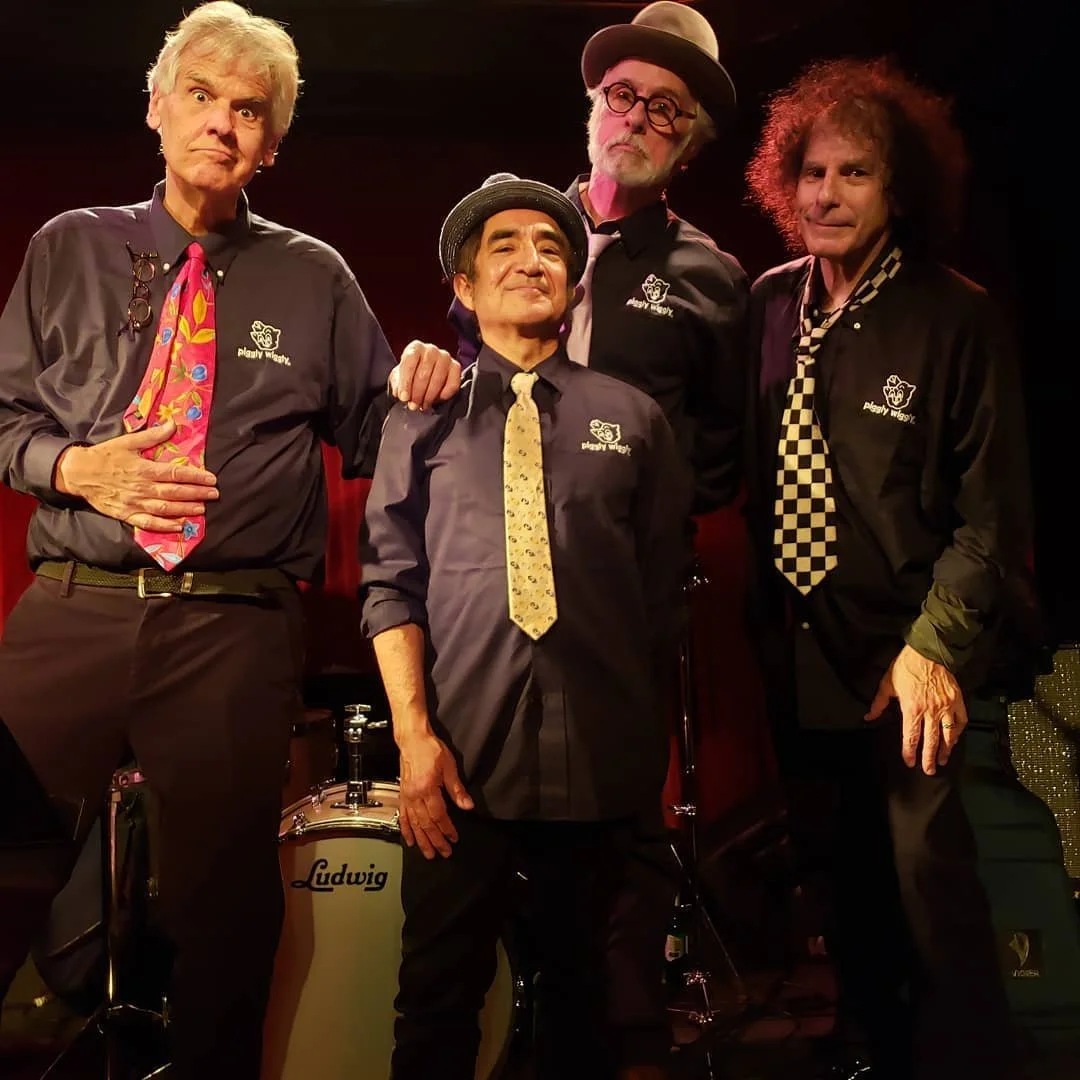
jackiO and the ties c. 2017. L - R : Steve Bartek, John Avila, David Raven, Ira Ingber. Photo by Linda Borthwick
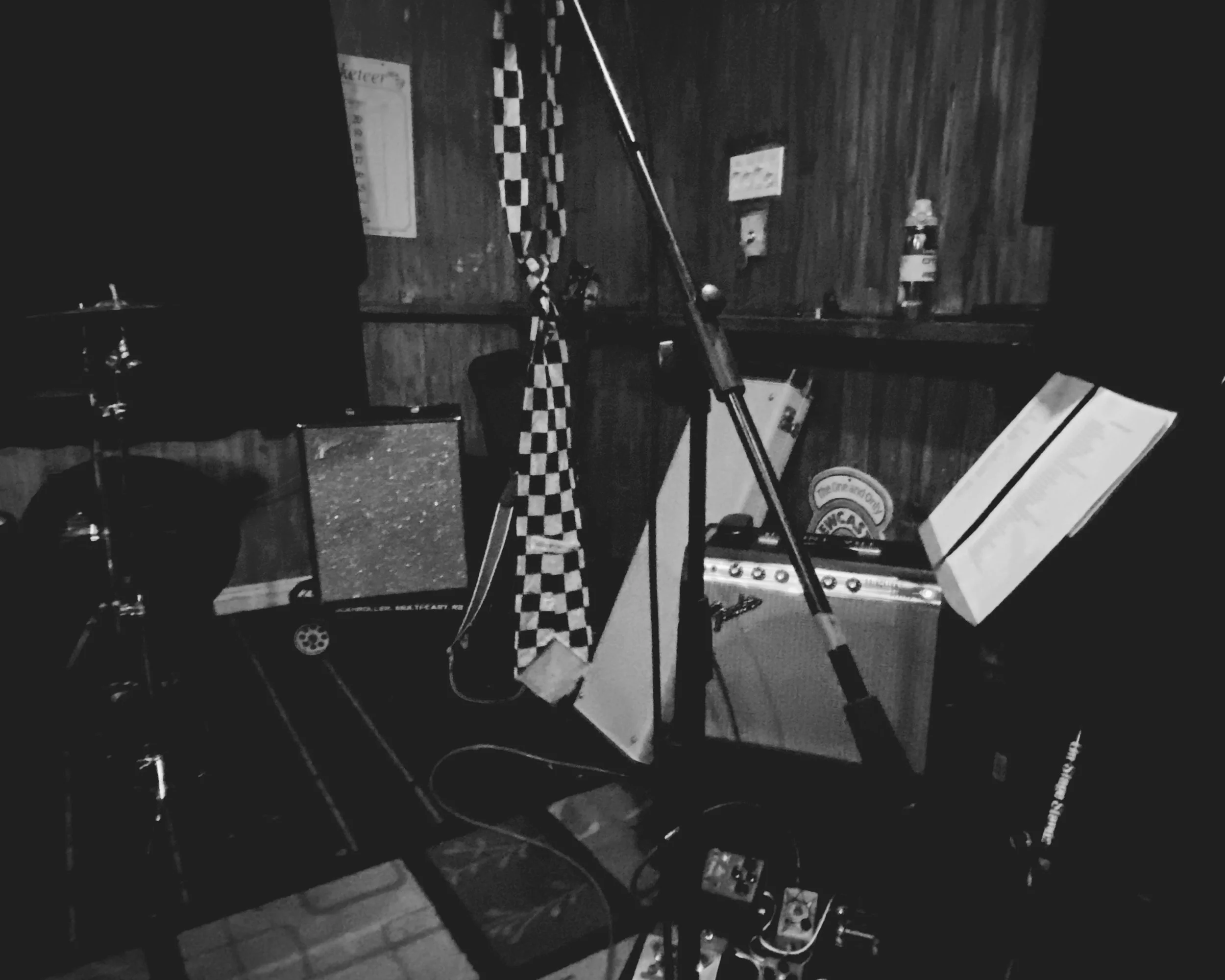
The checkerboard tie, hanging at Ireland’s 32
Gabi Chesnet
David has crazy fashion sense.
Ira Ingber
Oh, David's multifaceted. He's a good painter, very good painter. He has a very good eye. Very good photographer.
Gabi Chesnet
What can't he do?
Ira Ingber
He's a good cook. Yeah, I'm a good cook too. We've had cook-offs, him and I. But no, he's very visually oriented.
Gabi Chesnet
He was dressed up like he was going to a wedding.
Ira Ingber
Yeah, yeah. Well, what was funny that night when you saw us, he had another show that night to do, he double booked. That's why the drums were Steve's drums we brought in, it wasn't his kit. David, he continues to amaze me. So some years back - three, four years ago - we were setting up to play at Ireland's, which is this Saturday, I don't know if you're planning on coming?
Gabi Chesnet
Of course.
Ira Ingber
Great. So it's a little tiny club. I said, "Hi, how's it going?", we're setting up, "yeah, well, not feeling too good". "Oh, really?" "Yeah," he said, "Yeah, I'm gonna probably go to the emergency hospital after the show." I said, "What?!". He just kind of casually said it. "You're gonna go to the emergency room after the show. What about now?" "No, I think I'll be able to play." And sure enough, he played. He played great. Checks himself in, he was in there for two weeks, or a week! He had some heart stuff going on.
Gabi Chesnet
...He just played the show?
Ira Ingber
Played the show! Yeah! He's from Texas, so Texas' a little bit more casual... (mimics Southern drawl) They talk kinda like that... I mean he grew up there, but- "Yeah," this is my David impression, "Yeah, I'm gonna probably go to the emergency room." We all said, "What?!". I mean, I'd be crying at this point. "Oh, sorry guys, I gotta go. I'm about to die, so bear with me." So that's David.
Gabi Chesnet
He's definitely got this aura.
Ira Ingber
Oh, he's really something. And what a great drummer. You know a great drummer when you're playing with them, when you're singing, when you don't hear them. He's invisible. He's completely supportive and I mean, his groove is just wide, we call it a wide groove that - you can't play wrong. You can't rush or drag with him because it's like a big basket. Everything's gonna land in it, because he just creates this. If you noticed when he plays - you play a little drums, you said it yourself, right? You play drums.
Gabi Chesnet
Of course, that was the first thing I picked up.
Ira Ingber
Okay, so you know, the jazz drummers would hold... (demonstrating grip) It's a pen. Imagine this to be a pen. So jazz drummers hold the stick like this, right? They don't hold it like this.
Gabi Chesnet
The traditional grip.
Ira Ingber
Yeah, the drumstick's right here. They play like that.
Gabi Chesnet
Yeah, I was trained with jazz.
Ira Ingber
Okay, so that leads to a style of very fluid motion. It's almost like circles.
Gabi Chesnet
It was so interesting watching him.
Ira Ingber
Yeah. So he doesn't hold it (in matched grip), he holds like this. But he will also, when he does fills, when he hits the crash, he'll do that with it. (gestures) He doesn't do this. He, like...
Gabi Chesnet
He whips it.
Ira Ingber
He whips it. Exactly. Or when he does his (mimics drum beat), wham, it goes like- It's like these motions that create this great, fluid field. And again, last night, we were working. He wasn't at the session, he couldn't make it yesterday, but we were overdubbing to the tracks we had recorded, and we're listening to his drum parts. I pointed out to the guys, I said, "Look what he did here!". He created in this one song, it was a two bar phrase that he created as a pattern. I didn't know that at the time when we were playing, because I was busy just trying to get my part down. Now we're listening to it and we're hearing this beautifully constructed little painting he made. So he's got this one thing, (mimics drum beat). He created this little song within the song that adds this element of interest. I would never have thought of that programming, just forget it. This is what a drummer does. A drummer who writes songs, who sings, who knows music, so he's not playing drums, he's playing music on drums.
And talking about your shredding guitar player; guitar is a very difficult instrument. It's seductive- let me turn that around. It's seductive to make guitar music and not make music-music. What I mean by that is, you can play the guitar great and not make music. There's a lot of people who do that, and I shall not name them. You may know who I'm talking about, some of them. Because it's all technique, it's all dexterity. It's all virtuosity for virtuosity's sake.
Gabi Chesnet
Yeah, and you can be great at that.
Ira Ingber
Yeah, and I mean, a lot of people love it. Audiences just go, "Wow, he's so great", and I don't care about stuff like that. I don't care about "this person is so great". Am I getting anything? Are you telling me a story? Are you speaking to me musically through your instrument? Which is what I try to do. The greats who I looked up to - BB King is like the best example - You've heard of him? The Blues- okay, some people haven't. But three notes. You know, it's in- (sings notes). That's BB King. How did he do that? Because he's saying everything he needs to say very concisely, very deliberately, because he's making music. He's not playing the guitar. He's using the guitar to make music. A lot of people who I hear are playing guitar, and it's boring as hell to me.
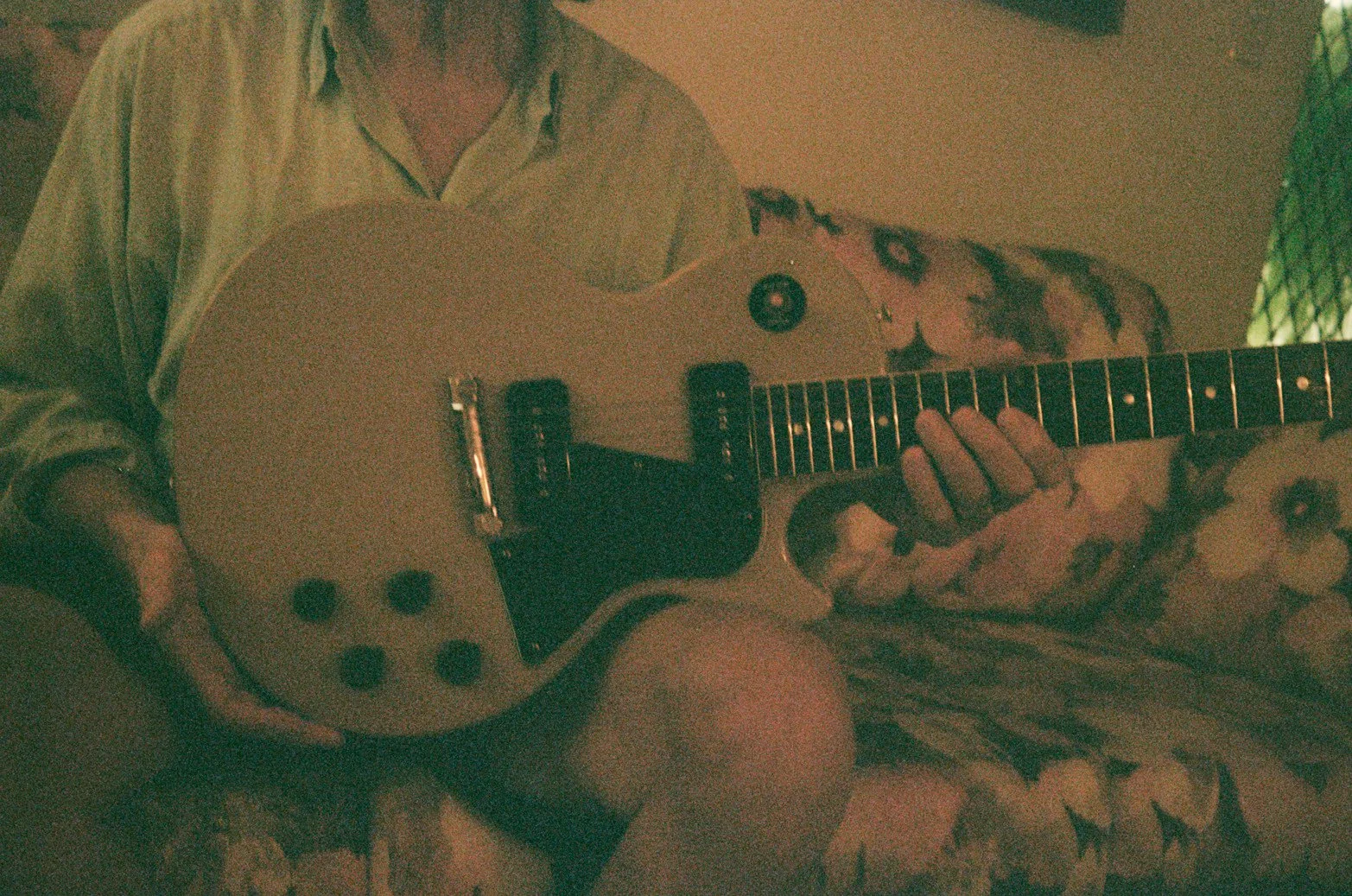
Ira’s Les Paul Special 1957 Historic Reissue
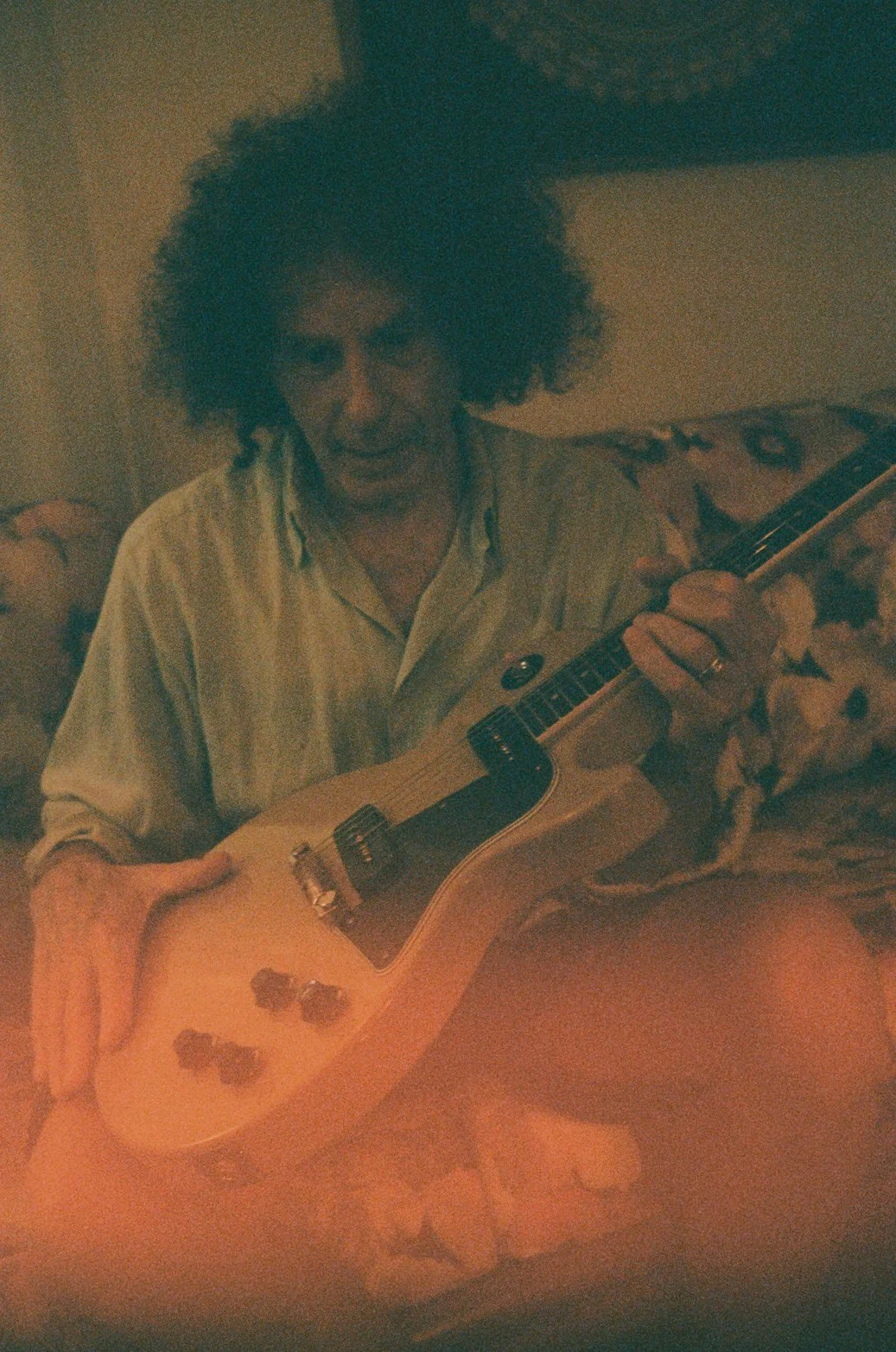
photos by Gabi Chesnet for AAR
Gabi Chesnet
David's got that independence of all his limbs, but also in his head.
Ira Ingber
Oh yeah, he's singing and he's playing. He's amazing. But he's making music.
Gabi Chesnet
That's what I think bodes well with the band. He just fits in perfectly, because when you have to not hear him, hear him blend in, he's blending in. But when you turn to him, as you said, he does something - you hear him do something.
Ira Ingber
Yeah. It's a real trick, again, that you don't get when you start out. You have to get to that point. He probably - I'm sure, when he was starting out - he couldn't do that. It takes a while to get there. Playing with a lot of different people, a lot of different musical contexts. You just draw from this, draw from that, draw from this and suddenly you have a sense of who you are. You know, there's a saying [from a] Native American people, you couldn't be a storyteller until you were 52 years old. Okay, well, that limits a lot of people's great work. But there's a lot of truth to that, that you haven't accumulated enough knowledge - from their perspective - until you are 52 years old. I take some issue with that, but there's a lot to be said about it in terms of what we're saying here. When you start out being, "I want to be a great piano player"; you listen to all the greats and you can play like them, you emulate perfectly your idol. Then at a certain point, you have to figure out who you are, and the idol starts to retreat a little bit. And then hopefully, the artist emerges in you, because we're all shaped by what influenced us.
Gabi Chesnet
It builds an identity, all these things.
Ira Ingber
Yeah, that's simple. I mean, the people who turned me on musically shaped my thinking, and then at a certain point, you let the training wheels fall off, and now you're going to be on your own. And, you know, I've been told by people that I have a sound that's recognizable, they know it's me. That's my goal. You know, I don't want to play like anybody else. I'm shaped by everything I've heard. There are people who I really looked up to, and there's a lot of them. Somebody more than once [asked me], "Who are your favorite guitar players?" I said, "Well, how much time do we have?" Hundreds, hundreds. There's a top 10, there's a top 20... Because I soaked it up like a sponge, the ones who really made me, who lit me up, and it came from various places.
Gabi Chesnet
I just wanted to say then, for the future right now; What's going on? What are the projects? You said you had a session?
Ira Ingber
Yeah, we are finishing. JackiO's gonna do more recording. Now that we can get back and play, we're gonna do more live stuff. I have nine pieces of original music that have not been put out, and because the album format seems to have become somewhat extinct, I don't know what exactly to do. I might release them as singles... I gotta consult - we have a manager for our band - I'm going to start to pick his brain about the best way to do this, because I can't play my things live. When you saw us, we started the second set with an original of mine, Laugh Track. We do a couple of originals of mine. But for the most part, I don't want to, I can't, I'm not even sure [I can] replicate what I want to do with my stuff with the band. JackiO writes its own stuff with all of us and that's easier to do. So more of that. I mean, figuring out what to do with my recordings.
I'm working with a really famous person right now I can't talk about because I had to sign an NDA, so that's going to be coming, hopefully soon I can talk about it. More producing of other people. I'm producing an act, the end of this month. They're called Cowboy Angst. Steven Casper's his name, and I've made four or five albums with him. We're going into the studio on the 29th, 28th. He has a band, so I produce his band. That's very rewarding, because I don't write the songs. I play a little bit on it, but I get to make a record I like out of his music. I get to make something out of it that I would want to hear, and he gives me carte blanche to do what I want to do. So long term is tough. You know, what do I see as long term?
Gabi Chesnet
It's stressful to think long term.
Ira Ingber
Yeah, it's difficult, because so much is moving so quickly now.
Gabi Chesnet
It's more like what's going on right now?
Ira Ingber
Exactly, yeah, I think the long term is, what we were saying earlier, is like figuring out where the world is now, because we're still sorting this out.
Gabi Chesnet
But you've got a lot on your plate as of now.
Ira Ingber
Yeah, I think so. Staying active, doing what I want to do, is essentially the key. I don't want to do that thing? I'm not going to do that thing. That's different than maybe even pre-pandemic, where I would do things just because it paid well, or it seemed like a good idea. But no, I think now it's focusing on the things that I really want to do, with people I want to be working with. And you know this too, this is hard work, and if you're working with someone who's not pleasant to be around, it makes it infinitely more difficult. So it's going to be people you feel in sync with, and people who are like-minded. Fortunately, everything I'm doing has that. All the projects I'm working with are people I want to be with, which is a major gift, very grateful for that. But it was something I consciously decided. It wasn't just "well, how did this happen?". It happened because that's what I wanted, and it's difficult. What's really important, a lifelong lesson which I've learned only not that long ago; it's important to focus on what you want, rather than what you don't want. "Well, I really don't want to have this-" No, you don't do that. "I want to do this." That directs you towards it. That's a hard thing to stay focused on. You get better at it.
So, I think that the long-short term of things is... You know, I've made music all my life. I've been very fortunate, I've never really had any other job. I delivered papers for a second as a kid, and I worked in a fabric store for a second, I was terrible at it. But music is all I've done. And just to bookend how we began, that would not have happened had I not been in Los Angeles. Clearly. And it wouldn't have happened except in the time in which I grew up. If I was a 10 year old kid now, when I started playing guitar at 12, I don't know if I would be a musician now. I really don't know, because so much has changed. What's the incentive? Maybe I'd be writing code. I don't know. It's a fair question. I've thought about it. But in those times, how could I not?
Gabi Chesnet
Time and place.
Ira Ingber
Time and place.
Gabi Chesnet
And you found what makes you happy, at least for the mindful moment. [II: Yeah.] Thank you very much for your time.
Ira Ingber
Well, thank you Gabi, this was very pleasurable.
Gabi Chesnet
Thank you. I'll keep everybody posted on your projects, and so on.
Ira Ingber
Great! Well, I'll keep you posted as well. I'll be sending you some stuff.
Cyd Levine
Musicians’ Teatime is a production of Acid Airplane Records, hosted by Gabi Chesnet and Cyd Levine. All episodes come with a full transcript and translation into French on the Acid Airplane Records website. Thanks for tuning in today!